

How to insulate a greenhouse overnight without electricity?
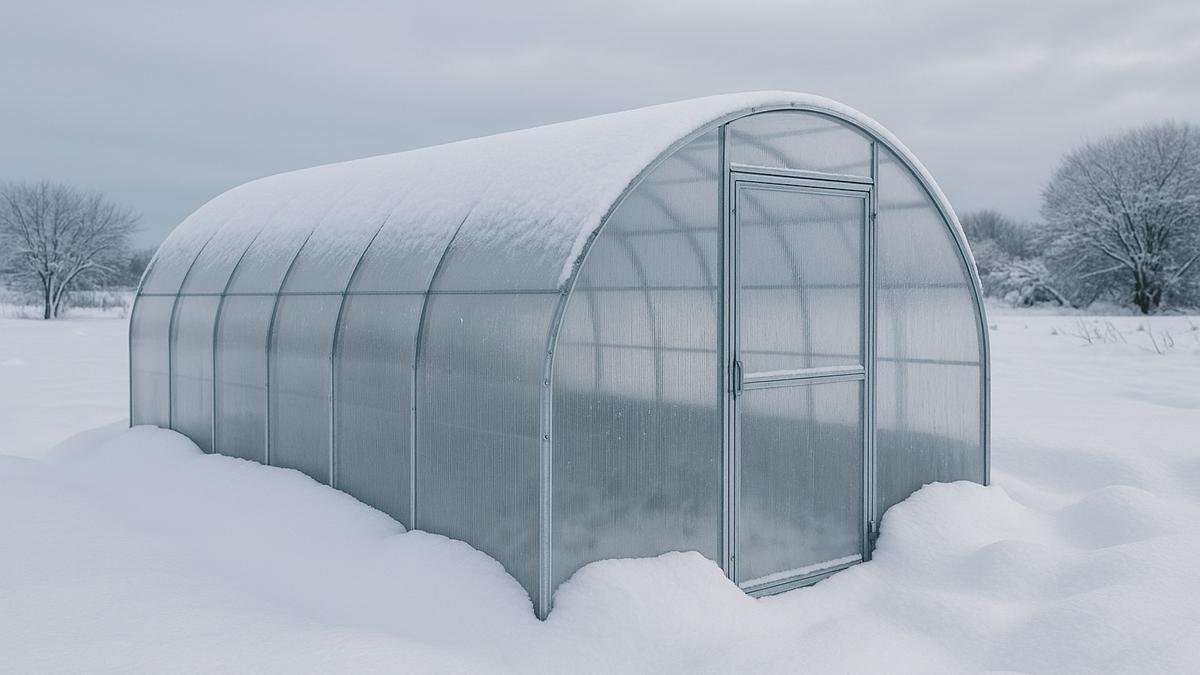
Night frost combined with an emergency power outage is a "perfect storm" for any greenhouse owner in Ukraine. The situation develops rapidly: at 22:00 the temperature drops to zero, boiler automatics and heat fans stop, and the thermal inertia of the film structure is counted in minutes.
At this point, the agronomist faces a wall of questions and pains:
- "Is one candle enough for 10 square meters, or is that an internet myth?"
- "Should I run to cover the seedlings with blankets, or will I just break the fragile stems in the dark?"
- "Which will kill my tomatoes faster: the cold or the carbon monoxide from the burner?"
- "How do you survive the four hours of pre-dawn peak cold when the temperature drops as low as possible?"
The pain of crop loss isn't just money for seed and fertilizer. It is months of labor crossed out by one night.
Our guide excludes "folk lore" and magical thinking on greenhouse insulation. We will only operate with the physics of heat transfer, available materials and emergency protocols for greenhouse insulation. Your job is not to heat the outdoors, but to create conditions incompatible with freezing of plant cell sap.
The physics of heat loss: Why does a greenhouse cool down instantly?
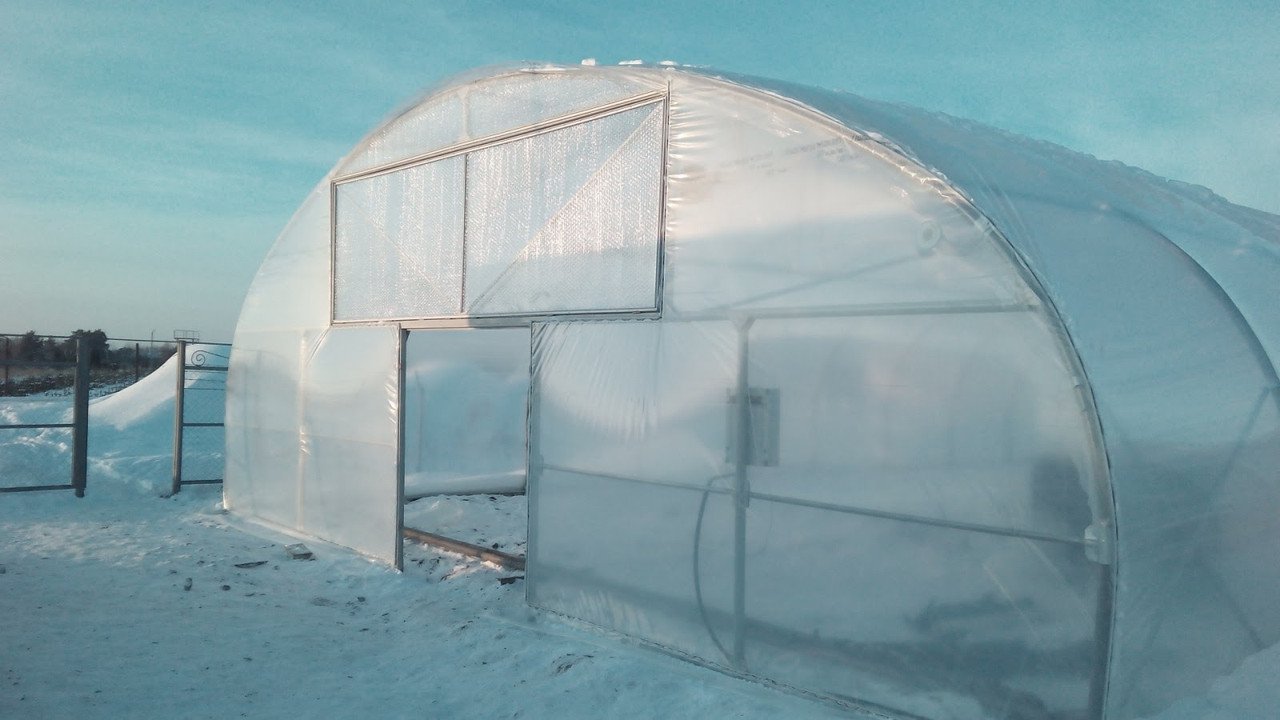
To effectively combat cold, it is necessary to understand the mechanism of heat loss at the level of physical formulas and material properties. A greenhouse is not just a "film over the ground", it is a complex heat exchanger.
Heat loss occurs through three channels: Transmission (conduction + convection), Infiltration (slits) and Radiation (radiation).
Radiative cooling (The Silent Killer).
The biggest mistake is to think that the greenhouse cools down only from contact with cold air. The main enemy on a clear, frosty night Long-wave infrared radiation (LWIR).
- The physics of the process: Soil and plants heated during the day radiate heat in the range of 7-14 microns. According to the Stefan-Boltzmann law, the radiation power is proportional to the fourth power of temperature.
- Spectral transparency: Conventional unstabilized polyethylene (PE) is transparent to thermal IR radiation at 70-80%. For heat, it is "almost nonexistent." Thermal radiation from the earth escapes unimpeded into the atmosphere, heating space.
- Glass and Polycarbonate: Unlike polyethylene, they are virtually opaque to LWIR (transmitting <5%). They work as a "trap" for radiation, creating a greenhouse effect. Film without special IR additives is not a greenhouse at night.
Thermal infrared (LWIR) permeability comparison table:
| Coating material | Thermal IR transmittance (%) | Expert's comment |
|---|---|---|
| Polyethylene (PE) conventional | 70-80% | "Hole" for heat. Requires shielding. |
| Polyethylene with IR additive | 15-20% | Professional "thermal films." |
| Glass (4 mm) | < 3% | A great barrier to radiation. |
| Polycarbonate (4-6 mm) | < 5% | Works like a screen. |
| Agrofiber (Spunbond) | 30-50% | Porous structure, works differently (insulates air). |
Heat transfer coefficient (U-value) and loss calculation
The second factor is the direct transfer of heat through the material. Here we do not operate with the heat transfer coefficient of the material, but with the heat transfer coefficient of the structure.
Comparison of building envelopes:
| Type of coating | U-value (W/m2K) | Losses from 100 m² at Δt=10 = 10°C |
|---|---|---|
| Single film (150 µm) | ~7.0 | 7,000 W (7 kW) |
| Glass (4 mm) | ~5.8 | 5 800 W |
| Polycarbonate (4 mm honeycomb) | ~3.9 | 3 900 W |
| Polycarbonate (10 mm honeycomb) | ~2.5 | 2,500 W |
| Supercharged double film | ~3.5 | 3,500 W |
Calculation output: For a standard 3x6 m dacha greenhouse (coverage area ~40 m²) under one film with a temperature difference of only 10 degrees (inside +5, outside -5), a power of 2.8 kW will be required just to compensate for heat losses through the film. It is practically impossible to compensate for such losses without electricity.
This is why the strategy of "warming the whole greenhouse" is doomed to failure. We have to change the equation: reduce the area S and improve U.
Matryoshka method: Reducing the heated volume
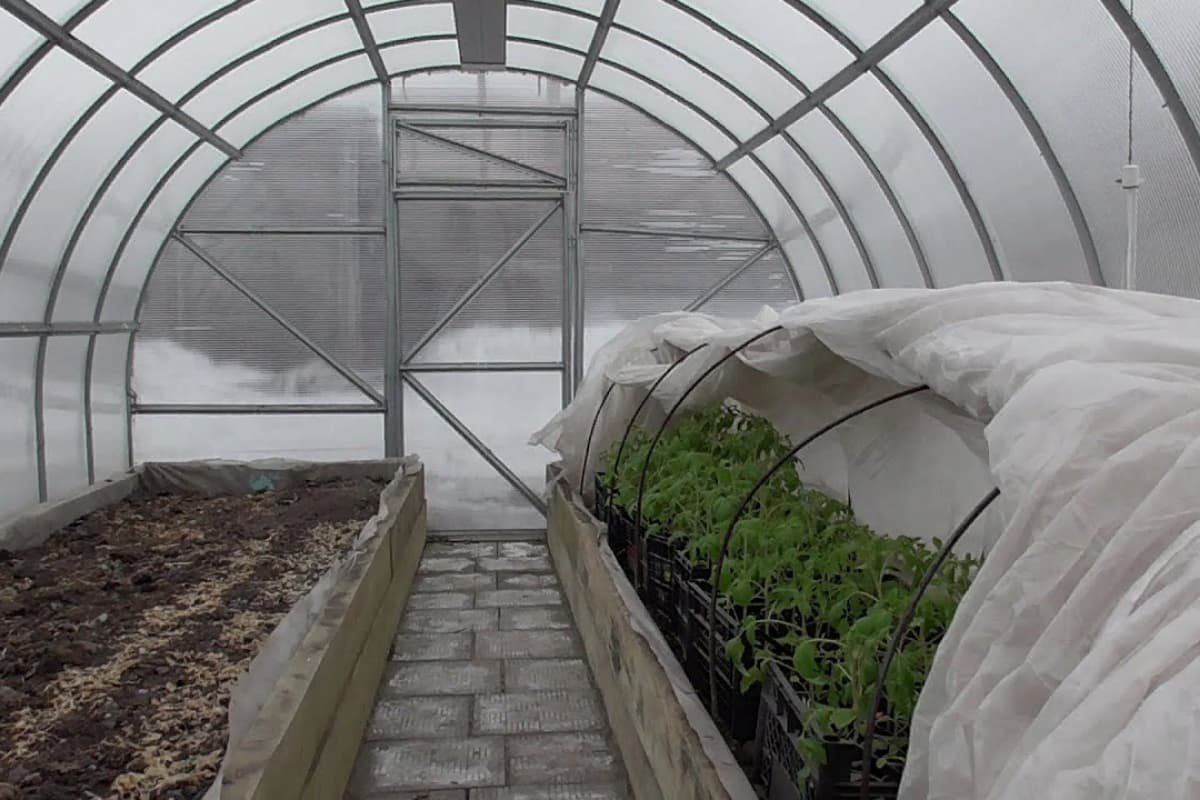
The most effective way to save plants without electricity is to stop heating the air under the ridge of the greenhouse and focus on the root zone and vegetative mass.
Double cover technology (Agrofiber/Spunbond)
In the conditions of Ukraine (climatic zones 5b-6a), the standard for emergency sheltering is the use of non-woven polypropylene material (agrofiber).
Important: The use of polyethylene film as a second layer directly on the leaves is prohibited due to the risk of condensation and subsequent frostbite at the points of contact ("cold compress effect").
Selecting material density (Labels)
For critical nights (down to -7°C outside), one layer is not enough to insulate the greenhouse. A combination is used.
| Density (g/m²) | Purpose | Light transmission coefficient | Temperature buffer (Δt) |
|---|---|---|---|
| 17-23 | Protection against light frosts, laying without arcs | ~80-85% | +2°C ... +3°C |
| 30-42 | Standard protection, requires a frame | ~65-70% | +3°C ... +5°C |
| 50-60 | Extreme protection (winter shelter) | ~50-60% | +5°C ... +7°C |
Action Algorithm:
- Install temporary arcs (6-8 mm composite rebar or 20 mm PVC pipe). Do not place dense fiber (50+) directly on fragile plants.
- Cover agrofiber with a density of 50 g/m² (brands available in Ukraine: Greentex, Agreen, Shadow).
- The edges are sealed against the ground (bricks, boards). A draft inside the small dome nullifies the effect.
Heat sources without electricity (Active thermal stabilization)
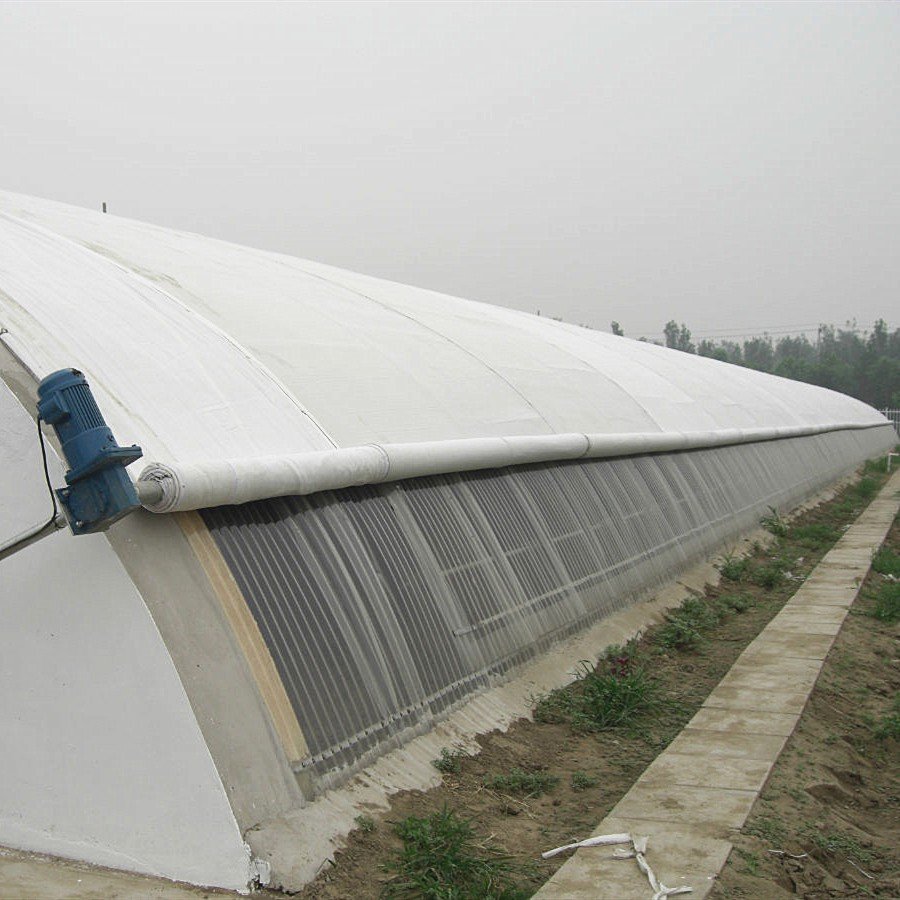
If passive insulation is not enough, we are obliged to introduce heat generation or heat recovery sources into the system. Let's consider them from the point of view of physics and efficiency.
Liquid heat accumulators (Water)
Water is the most accessible and efficient heat carrier in nature due to its unique heat capacity of 4187 J/(kg-K). For comparison: concrete - 880, brick - 840, dry ground - 800.
Physics of the process (Two phases of defense):
- Cooling phase: As long as water is liquid and warmer than air, it gives off heat.
- Calculation: 1 liter of water, cooling by 1 degree, releases 4.18 kJ of energy.
- Practice: 100 liters of boiling water (90°C), cooling to greenhouse temperature (10°C), will release: Q = 100kg × 4.18 × (90-10) = 33,440 kJ = 9.3 kWh.
- This is the equivalent of running a 2kW oil radiator for 4.5 hours continuously.
- Crystallization Phase (Latent Heat): This is the "airbag". If the temperature drops to 0°C, the water starts to freeze.
- The transformation of 1 kg of water into ice releases a colossal amount of energy: 330 kJ/kg.
- This is 80 times more than when water cools by 1 degree.
- Effect: Freezing water "holds" the temperature of the air around it at 0°C, preventing it from dropping lower until all the water has turned to ice. This often saves plants from dying at -2°C outside.
Water accumulator efficiency table:
| Tank type | Volume (l) | Energy stored (90°C -> 20°C) | Fan heater equivalent (1.5 kW) |
|---|---|---|---|
| PET bottle | 2.0 | 0.16 kWh | 6 minutes of work |
| Canister | 20.0 | 1.62 kWh | 1 hour of work |
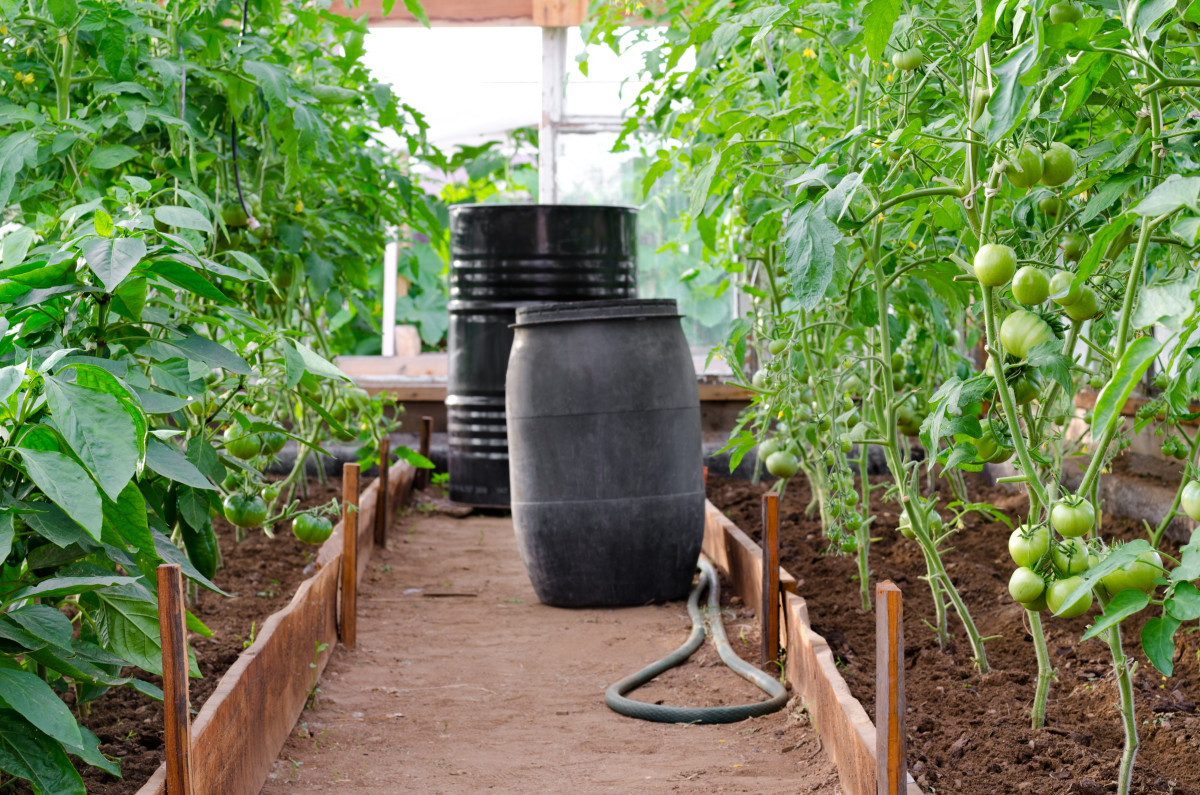
| Iron barrel | 200.0 | 16.2 kWh | 10 hours of work |
Recommendation: Use small containers (PET 2-5L) and distribute evenly inside agrofiber shelters. The barrel is effective, but it warms one spot.
Paraffin emitters (Myths and reality of candles)
There is a popular myth on the internet that "one candle will save a greenhouse". Let's do the math.
Technical data:
- Calorific value of paraffin: ~46 MJ/kg (almost the same as gasoline).
- A standard household candle weighs ~50-80 grams and burns for about 8 hours.
- Combustion rate: ~10 grams per hour.
- Power of one candle: Q = (0.01 kg/h × 46,000 kJ/kg) / 3600 sec ≈ 0.127 kW = 127 watts.
Reality: One candle generates as much heat as one light bulb. To heat an 18 m² greenhouse that loses 2 kW of heat, you need 15-20 candles at a time.
Ceramic afterburner" design (To increase efficiency): The main problem with a candle is convection. The hot air (a trickle of heat) goes strictly upward under the roof where it is useless. We need to convert convection into infrared radiation that warms objects around us.
- Assembly: Threaded rod, washers, nuts. String three clay pots of different diameters (e.g. 15 cm, 12 cm, 8 cm) one into the other upside down.
- Principle: The flame heats the inner pot to 200°C+. That one heats the air inside the middle one. The outer pot is heated to 60-70°C.
- Result: The ceramic becomes a heat emitter. You get a "battery" that heats the sides, not the ceiling.
Consumption rate: 1 such emitter for every 2-3 linear meters of the bed under with arcs.
Gas generation (Propane-Butane)
The most powerful way, but also the most dangerous.
Process Chemistry: Combustion of propane (C3H8): C3H8 + 5O2 → 3CO2 + 4H2O + Heat
Two byproducts to be aware of:
- Water (H2O): When 1 kg of gas is burned, 1.6 kg of water vapor is released. The humidity in the greenhouse will instantly increase to 100%. This is the risk of fungal diseases (gray rot) in 2-3 days. Ventilation in the morning is required.
- Ethylene (C2H4) and CO: In case of incomplete combustion (yellow flame, lack of air), ethylene, a plant aging hormone, is released. Concentrations above 0.05 ppm cause leaf curling ("epinastia") and ovary drop in tomatoes.
Comparison of burner types:
| Type | EFFICIENCY | Peculiarities | The expert's verdict |
|---|---|---|---|
| Open burner (Hob) | Low | Heat escapes upwards. High risk of incomplete combustion. | I don't recommend it. Dangerous to plants. |
| Ceramic IR panel | High | The ceramic heats up to 800°C. Burns gas cleanly. Heats by radiation (IR). | Best choice. (power 2-4 kW). |
| Catalytic | Medium | Flameless oxidation on fiberglass. Safer, but more expensive. | Good for small volumes. |
Safety protocol (strictly):
- The gas cylinder must be kept warm (gas freezes and pressure drops), but not closer than 1 meter from the burner.
- Micro-ventilation (1-2 cm slit in the window) for oxygen supply is mandatory. Without oxygen, combustion will produce carbon monoxide (CO), which will kill you when you enter the greenhouse in the morning.
Sealing and working with soil
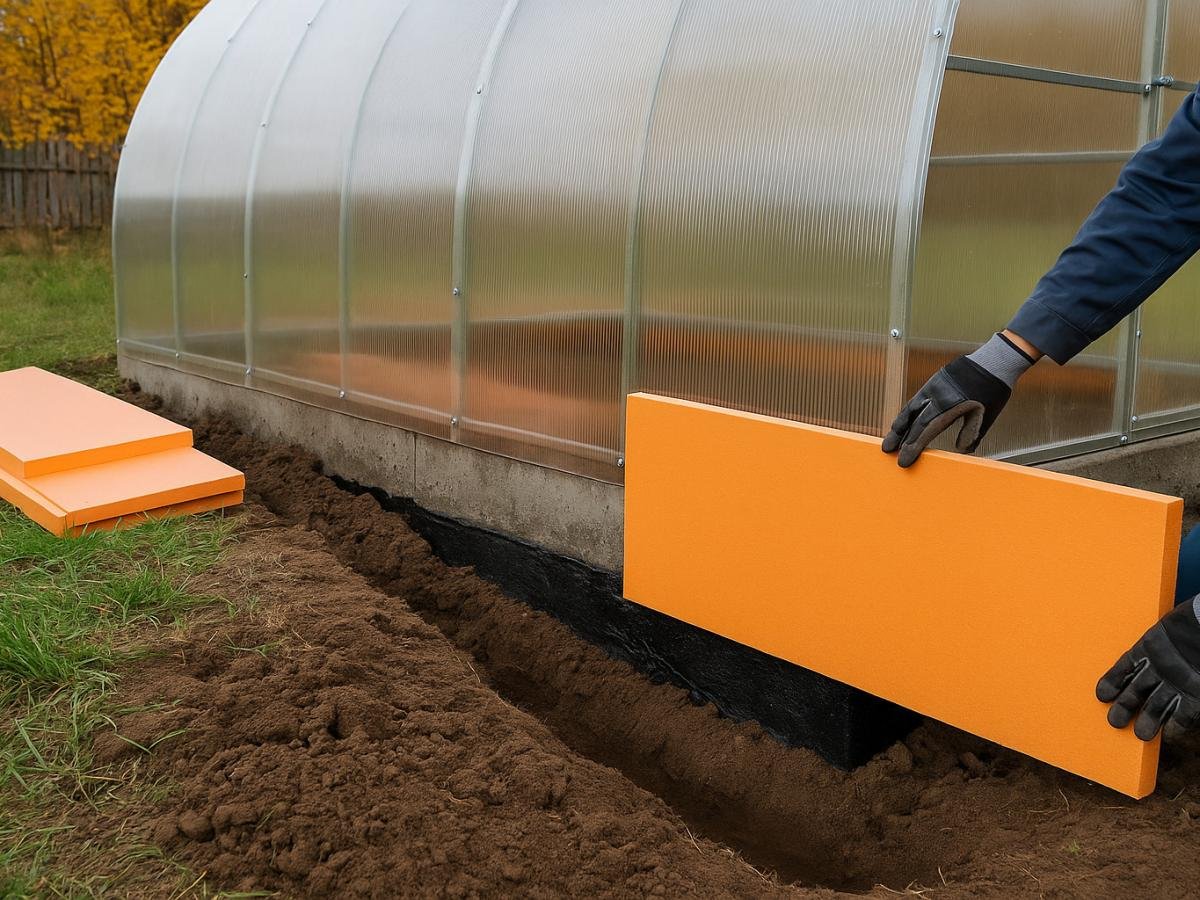
Protecting the greenhouse "roof" is only 70% of success. The remaining 30% of heat loss comes from the ground and air infiltration. And the cold coming from the ground is the most dangerous, because it cools directly the root system (rhizosphere), which is less resistant to temperature changes than the above-ground part.
The physics of the "edge effect" (Cold Bridge)
Wet soil is a poor thermal insulator. Its thermal conductivity is 1.5 - 2.0 W/(m-K) (for comparison, that of foam plastic is 0.035).
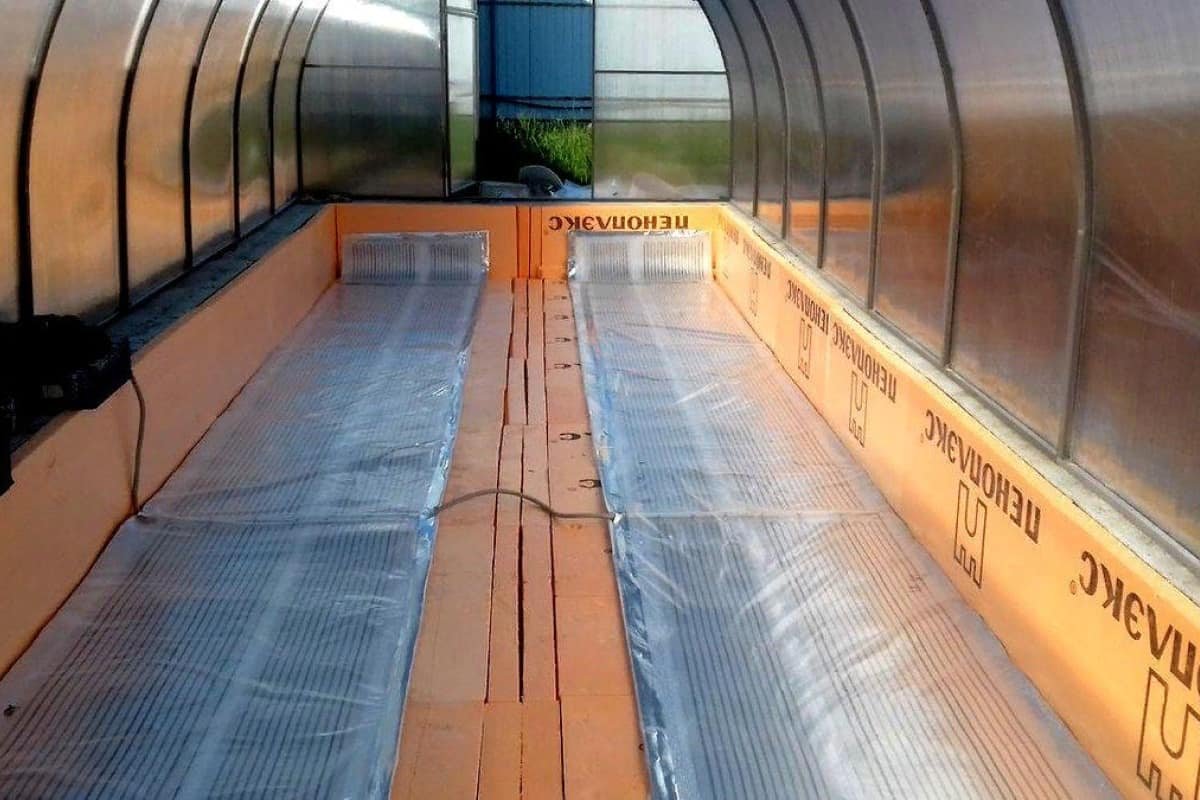
On a frosty night, the ground freezes from the sides of the greenhouse to the inside. The cold moves in a wedge under the foundation. If the greenhouse does not have an insulated basement, after 4-5 hours of frost, a strip of ground 30-50 cm wide from the wall inside the greenhouse will have a temperature close to the street temperature. The roots of plants in this zone will be the first to die.
Emergency External Isolation (The First Line of Defense)
Objective: to move the zero point (0°C isotherm) away from the perimeter of the greenhouse.
Engineering snow protection
Snow is water with air (porosity up to 90%). Its heat transfer coefficient depends on its density.
| Snow condition | Thermal conductivity (W/m-K) | Insulating properties |
|---|---|---|
| Freshly fallen, fluffy | 0.10 - 0.15 | Excellent (like wood) |
| stale, old | 0.35 - 0.40 | Averages |
| Trampled (ice) | 2.20 - 2.30 | None (spends cold!) |
Instructions: Cover the bottom of the greenhouse with 50-70 cm of snow. It is strictly forbidden to trample snow on the walls - you will turn the insulator into a cold bridge!
Thermal insulation boards (XPS vs EPS)
If there is no snow, use sheet insulation. In Ukraine, two types are common: white ball foam (EPS, PSB) and colored extruded polystyrene foam (XPS).
Why only XPS (Stirodur, Penoplex, Technoplex) is suitable for the ground:
- Water Absorption: EPS (white) absorbs up to 2-4% of water, losing properties. XPS absorbs less than 0.2%. In wet environments "near the ground" only XPS works.
- Recommended Thickness: 30mm is enough for an emergency night, 50mm is the standard for winterizing.
- Installation: The sheets are simply placed against the basement and pressed down with a brick. This cuts off the contact of frozen air with the bottom of the greenhouse.
Internal mulching (Breaking the thermal bridge)
The earth is a huge heat accumulator (+10...+12°C at depth). Our task is to prevent this heat from escaping into the cold air of the greenhouse. To do this, we create an insulating layer on the surface.
Table of effectiveness of mulching materials:
| Material | Heat transfer coefficient (W/m-K) | Required layer (cm) | Peculiarities |
|---|---|---|---|
| Dry straw | 0.05 - 0.07 | 10 - 15 cm. | A leader in efficiency. It is important that it is dry. |
| Sawdust | 0.09 - 0.12 | 5 - 10 cm. | Can acidify the soil. |
| Agrofiber (black) | 0.35 (notional) | 2 layers (60 g/m²) | It works due to the air gap, not the thickness. |
| Wet soil | 1.50 - 2.00 | - | It is itself a conductor of cold. |
Advice: If the soil is warm, cover it up on top ofto keep the roots warm. If the ground is already frozen, do not cover it, you will "forbid" the cold inside.
Sealing of infiltration (Air seals)
Heat loss through gaps (infiltration) can be as high as 40% of total losses during windy conditions.
- Rule n50: Even a 2 mm slit 1 meter long in a 5 m/s wind pumps up to 10 cubic meters of warm air out of the greenhouse per hour.
- Solution: Use regular wide tape to seal the joints of the shutters and doors. For gaps near the ground (where the tape does not stick), use "rollers" made of old rags or primer.
Summary table of method effectiveness (at Δ street/greenhouse)
| Method | Difficulty of implementation | Cost (UAH) | Efficiency (Δt increase) | Note |
|---|---|---|---|---|
| Agrofiber 50 g/m² (tunnel) | Low | ~30-40 UAH/m.p. | +4°C ... +6°C | Basic Method. Required. |
| Boiling water bottles (per 1 m²) | Average | Water + Energy | +2°C ... +3°C (for 4-5 h) | Requires a hot water source. |
| Candle heater (ceramic) | High (assembly) | ~150 UAH/pc | +1°C ... +2°C (locally) | Fire hazard. It needs to be controlled. |
| Gas IR heater (4 kW) | Low | ~2500 UAH + gas | +10°C ... +15°C | Risk of poisoning of plants by combustion products. |
| Smoking (grandfather's method) | Average | It's free | +1°C ... +2°C | Messy, ineffective in small volumes. Not recommended. |
Safety precautions and approvals
- CO levels: In a closed greenhouse, if an open fire (gas, candles, kerosene) is used, the oxygen level drops critically fast. You can enter such a greenhouse in the morning only after ventilation (open the door for 2-3 minutes without entering).
- Fire Safety: The distance from the open flame (candle) to the agrofiber should be at least 50 cm vertically. The agrofiber melts instantly.
- Critical temperatures for crops (Ukraine, State Register of Varieties):
- Tomatoes: Growth arrest at +10°C. Irreversible damage at +2°C...0°C.
- Cucumbers: Fatal at +3°C...+4°C (at high humidity).
- Cabbage/ Onions: They can withstand short periods down to -3°C...-5°C.
"One Hour Before Sunset" checklist.
If the forecast says frost and there's no light:
- Sealing: Duct tape all gaps in doors and shutters.
- Inner dome: Install arcs and cover the beds with agrofiber (density 30-50).
- Batteries: Place hot water bottles under the agrofiber (but not touching the stems!).
- Outer Perimeter: If possible, cover the bottom of the greenhouse from the outside with any material (cardboard, old carpets, foam).
- An agronomist's prayer: Check the forecast for 4:00 - 5:00 am (coldest time) and set an alarm to monitor.
How to insulate a greenhouse overnight without electricity: Survival Formula
Insulating a greenhouse without electricity is not a chaotic set of white-knuckle know-how, but a rigorous engineering equation where we control three variables: Energy (E), Volume (V) And Time (t).
Your strategic goal is not to heat the greenhouse to +20°C (this is impossible without a generator), but to slow down the temperature drop inside the shelter ("tunnel") so that the cooling curve does not cross the freezing point of cell sap (about -1.5°C) before sunrise.
Temperature Chronology of the Night (Fighting for Time)
The most dangerous period is not midnight but the pre-dawn hours. The cooling schedule of the greenhouse is not linear:
- 22:00 - 02:00: The temperature drops rapidly, but is still held by residual soil heat.
- 04:00 - 06:00: Critical point. Radiation of heat by the ground is weakening and cold air from the street (frost peak) is maximizing pressure on the structure. It is during these 2 hours that 90% of the crop dies.
Conclusion: Heat accumulators (boiling water) should not be laid in the evening, but as late as possible (at 23:00-00:00), so that the peak of their heat output is during the coldest hours.
Final survival equation (no mysticism)
Instead of abstract advice, use this formula for calculating the odds of success:
Success = (Mass Heat Capacity / Shelter Volume) × Insulation Quality
Where:
- Heat capacity of mass: It's the amount of water. 50 liters of boiling water is better than 100 kg of heated bricks.
- Shelter volume: By reducing the volume by a factor of 10 (covering only the bed, not the entire greenhouse), you increase the efficiency of your water bottle by a factor of 10.
- Insulation quality: It's draft-free. One slit zeroes in on the job of 10 water bottles.
Triage" decision-making protocol (Sorting)
In an emergency (lights out, colder than forecast, no firewood), follow the protocol of medical triage, sacrificing the lesser for the sake of preserving the essential:
| Priority | Action | Justification |
|---|---|---|
| Zone 1: Life | Sealing of the inner dome | If there is not enough agrofiber for everything - cover only the most valuable (seedlings) in 2-3 layers. Leave the rest. Saving 30% of seedlings is better than freezing 100% of adult bushes. |
| Zone 2: Energy | Water in the perimeter | Move all water containers close to the plants in a small shelter. The bottle outside the arcs warms the air, the bottle inside warms the plant. |
| Zone 3: Security | CO control | If you are using the burners inside the greenhouse but feel drowsy, leave immediately. No crop is worth a life. Carbon monoxide has no odor. |
Agronomy in a risky farming zone is risk management. Plants have an amazing will to live. A short-term drop in air temperature to +1°C is acceptable as long as the roots are warm and the leaves do not touch the ice film.
Your main tool this night is not a burner, but a 50 g/m² agrofiber and a supply of hot water. Prepare these two components in advance, and no power outage will be fatal to your greenhouse.






 English
  Русский
  Українська