

Why it's always colder in the corners of the greenhouse and how to fix it: The physics of cold and 5 engineering solutions to the problem
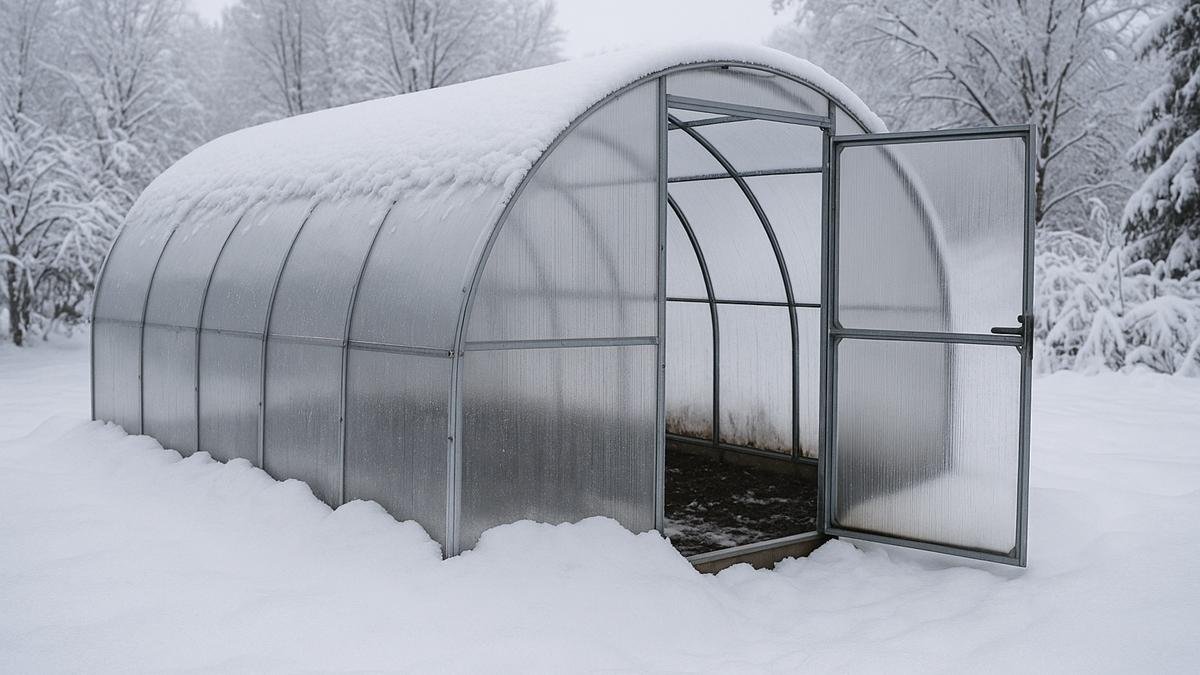
Do you know this situation? You enter your greenhouse in early spring. The thermometer in the center, hung at eye level, reads a comfortable +18°C. The seedlings look cheerful. But when you look down into the corners of the structure, the picture changes. Tomato leaves there have a bluish hue, cucumbers are stunted, and condensation or even frost accumulates on the polycarbonate.
It's not an accident or an error in your thermometer. "Cold Corner Effect." - is a physical inevitability of most standard designs that deprives gardeners of up to 15-20% of usable space and crops each year.
Why is it always colder in the corners? Why doesn't an expensive stove save the outermost beds? And most importantly - how to turn dead zones into a space for active growth, using materials available in Ukraine? Let's analyze the problem from an engineering point of view.
Process physics: Why is the corner a cold bridge?
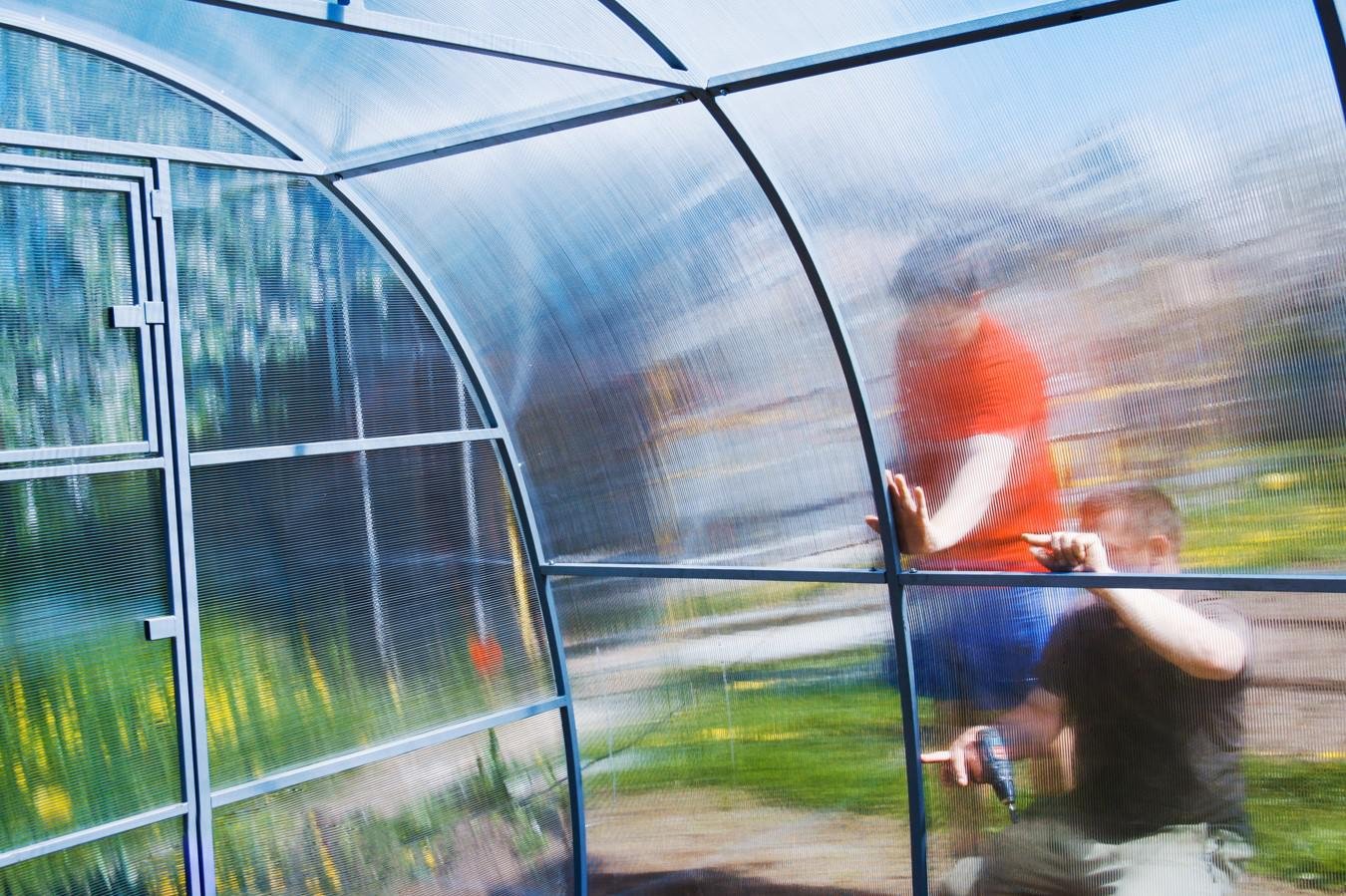
To eliminate the cause, rather than fight the effects, you need to understand the thermodynamics of the process. There are three fundamental factors at work here that turn the corner into a "black hole" for heat.
1. Geometric factor and radiative cooling
Any object in the greenhouse loses heat not only through contact with the air, but also through infrared radiation.
- The wall: A plant standing against a flat wall "sees" a warm greenhouse in front of it (180 degree view) and only one side of it a cold wall.
- Corner: The plant in the corner is surrounded by cold surfaces on both sides (270 degree cold viewing angle).
Technical fact: The ratio of cooling surface area to air volume in the corner area is 2-2.5 times higher than in the center. The polycarbonate in this area acts as a huge radiator, dumping heat into the atmosphere, especially on clear, cloudless nights.
2. Archimedes' Law and "cold lakes"
This is the main reason why roots in corners freeze. Cold air is physically heavier (denser) than warm air.
- As the air cools against the polycarbonate walls, it begins to flow downward, creating a downward convective flow.
- In the center of the greenhouse, this flow is picked up by heat from the soil or heater and rises again.
- An aerodynamic dead end is formed in the corner. This is where the flows from the two walls come together. Due to friction on the surfaces, the air velocity drops to zero.
Result: A heavy, icy lens of air accumulates at the bottom, which natural convection is unable to "push out" and warm. This phenomenon is called a "cold lake".
3. cooling fin effect (Thermal conductivity of the frame)
Polycarbonate itself is not a bad insulator (thanks to the honeycomb with air). But the frame is metal.
- The thermal conductivity of steel is hundreds of times higher than that of air or plastic.
- It is in the corners where the maximum amount of metal is located: corner posts, bolt connections, stiffeners, "braces", door hinges.
From an engineering point of view, the corner of the metal frame works like a cooling fin in electronics, only vice versa - it intensively pumps heat out of the ground and air and transfers it outside. If the profile does not have a thermal break (and in domestic greenhouses it does not), the metal in the corner will always have the street temperature.
Diagnosis and norms for Ukraine
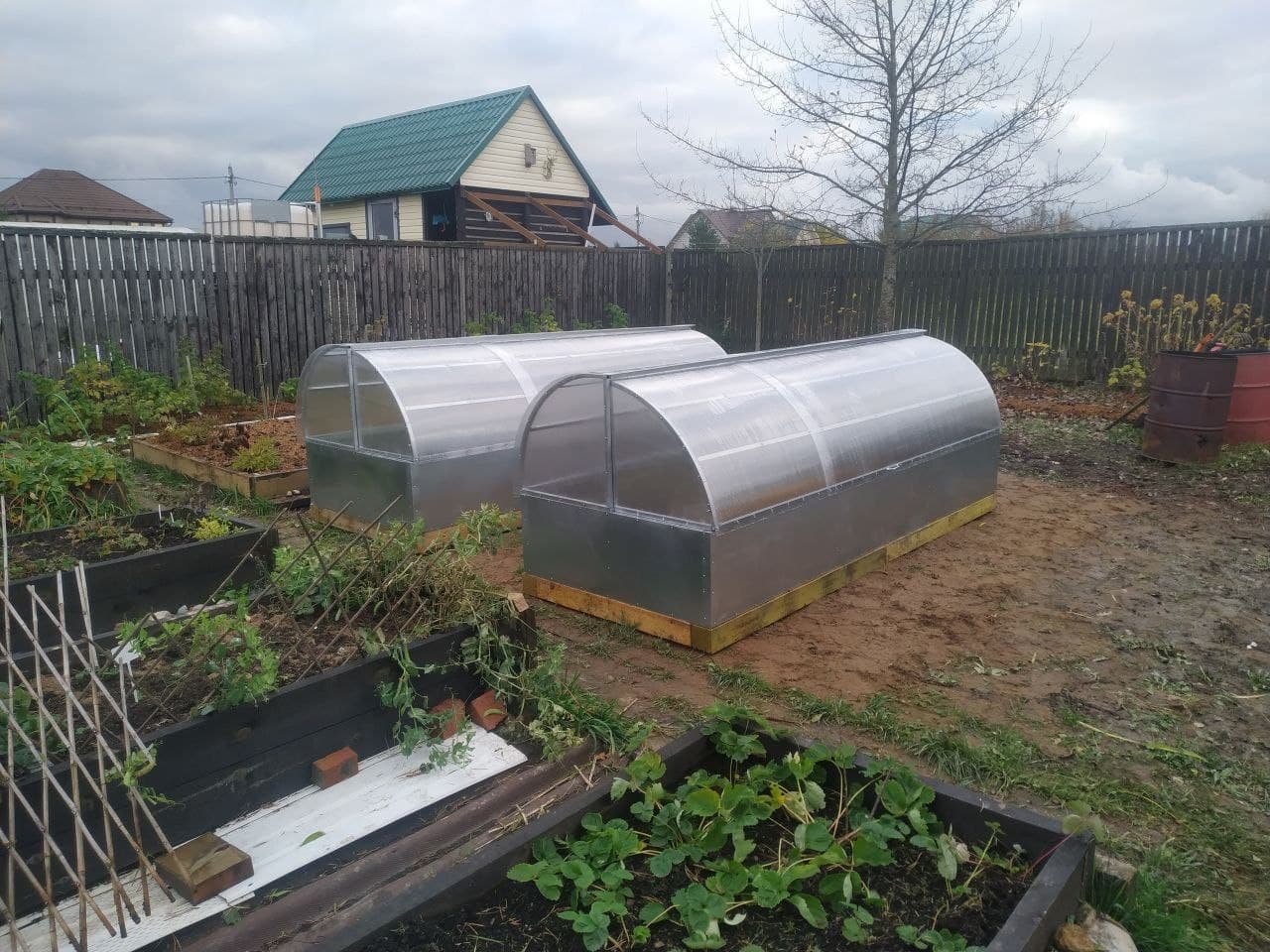
Before you insulate, you need to measure.
How to check your greenhouse:
- Pyrometer (infrared thermometer): Point it at the polycarbonate in the center and in the corner. If the difference is more than 3-4°C, you have a serious problem.
- Candle test: On a windy day, walk around the inside corners with a candle. If the flame fluctuates, the seal is broken.
Climate realities
For most regions of Ukraine (Kyiv, Kharkiv, Lviv regions) the depth of ground freezing is as follows 0.8 to 1.2 meters.
- Error: Put the greenhouse simply on the ground or on a bar without insulation. The ground in the corner freezes on both sides (end and side), turning the soil inside the greenhouse into an icy monolith.
Technical solutions: From simple to complex
We've covered the physics, now let's move on to engineering practice. To eliminate cold corners, you need to take a holistic approach: cut off cold from below, block draughts and redistribute heat. Below is a detailed breakdown of methods with proven effectiveness.
Solution #1. Thermal cutoff of the foundation (Base)
The essence of the problem: Concrete strip foundations or metal piles have a high thermal conductivity (concrete conducts cold 50 times better than insulation). Without insulation, the foundation acts as a powerful perimeter ground cooler.
- Technical Solution: Creating a closed loop from extruded polystyrene foam (XPS). Unlike Styrofoam, XPS has a closed cell structure, does not absorb moisture from the soil and is not destroyed by freeze/thaw cycles.
- Materials: XPS boards 30-50 mm thick (e.g. Carbon Eco, Penoplex).
- Instructions: Sheets are buried vertically along the outer perimeter to the depth of freezing (or at least 40-50 cm) and protrude above the ground up to the joint with the polycarbonate.
- Effect: Shifts the "dew point" and the frost zone outside the bed. The soil temperature in the corner increases by 3-5°C.
Solution #2. Sealing: Elimination of infiltration
The essence of the problem: Infiltration (blowing) is uncontrolled air exchange. In windy weather, the greenhouse can lose up to 40% of stored heat per hour through micro gaps in the corners. Conventional self-tapping screws break the holes as the polycarbonate thermally expands, creating gaps.
- Technical Solution: Use of plastic sealants that retain elasticity in freezing temperatures.
- Materials:
- Butyl rubber tape (K2): Does not cure, works as a double-sided adhesive tape between the frame and polycarbonate.
- Heat washers: Mandatory for fasteners. They have a foam or rubber foot to block the cold bridge from the self-tapping screw.
- Comparison: Silicone sealant often peels off after a year due to wind vibrations. Butyl tape lasts up to 10 years.
Solution #3. Double Facade" method (Inner Cocoon)
The essence of the problem: Single-layer polycarbonate (4-6 mm) has a heat transfer resistance R ≈ 0.25. This is not enough to retain heat during frosts.
- Technical Solution: Creating a fixed air layer. Air is the best free thermal insulator, but only if it is stationary.
- Implementation: A second layer of film or thin polycarbonate is mounted in the corners with a gap of 2-4 cm from the main wall.
- Lifehack: The use of UV-stabilized air bubble film (ABF). The air bubbles work like hundreds of micro-cameras.
- Result: The heat transfer resistance of the corner zone is almost doubled.
Solution #4. Liquid heat accumulators (Inertial stabilization)
The essence of the problem: The air in the greenhouse cools down quickly (low heat capacity). The ground cools more slowly, but in the corners it cools on both sides.
- Technical Solution: Use of water as a buffer. The specific heat capacity of water (4200 J/kg-°C) is 4-5 times higher than that of soil or concrete.
- Implementation: Black water canisters (PET, 5-10 liters) are placed close to the corner posts.
- The physics of the process: 100 liters of water, cooling down by 1 degree, gives off as much heat as a small 1 kW fan heater produces in 7 minutes. Overnight, cooling the water by 10 degrees will release a huge amount of energy, mitigating the temperature drop in the problem area.
Solution #5. Air destratification (Fans)
The essence of the problem: Thermal stratification. Warm air accumulates under the ridge (it can be +25°C there) and in the corners near the floor there is a stagnant zone (+10°C).
- Technical Solution: Forced mixing of air masses by low-power fans.
- Implementation: Computer coolers (12V) or special greenhouse circulators are installed in corners and blow along walls, breaking up "cold pits" and blowing warm air from above.
Comparative table of effectiveness of methods
| Method | Difficulty of installation | Price | Efficiency (°C) | Note |
|---|---|---|---|---|
| Foundation insulation | High (earthworks) | Medium (XPS) | +3... +5°C (ground) | Base. It's done once and for all. |
| Joint sealing | Low | Low | +1... +3°C (air) | Critical for windy regions. |
| The inner "cocoon" | Average | Low | +2... +4°C | Saves seedlings during spring frosts. |
| Water batteries | Very low | It's almost free | Peak smoothing | It doesn't get warm, but it doesn't let it cool down drastically. |
| Fans | Medium (electrical) | Low | T° equalization | Eliminates dampness and fungus in corners. |
Choosing polycarbonate: Labels and quality
Often the corner is cold simply because the covering is too thin. For winter and early spring greenhouses in Ukraine, the standards are as follows:
| Type of greenhouse | PC thickness | Density (kg/m²) | Recommendation |
|---|---|---|---|
| Seasonal (Apr-Oct) | 4 mm | 0.52 - 0.60 | Acceptable, but the corners will be cold |
| Early (March-November) | 6 mm | 0.80 - 1.10 | Optimal balance |
| Winter (All Year Round) | 10 mm | 1.50 - 1.70 | Must be multi-chambered |
Important: When buying a greenhouse, ask for the specific weight of the polycarbonate.
- If you are offered "quadruple" (4 mm) with a weight of 0.45 kg/m² - this is a "lightweight" version. It does not hold heat.
- Quality polycarbonate has UV protection in the mass or co-extrusion layer, not just a spray-on varnish.
Design matters: Why are arched ones better?
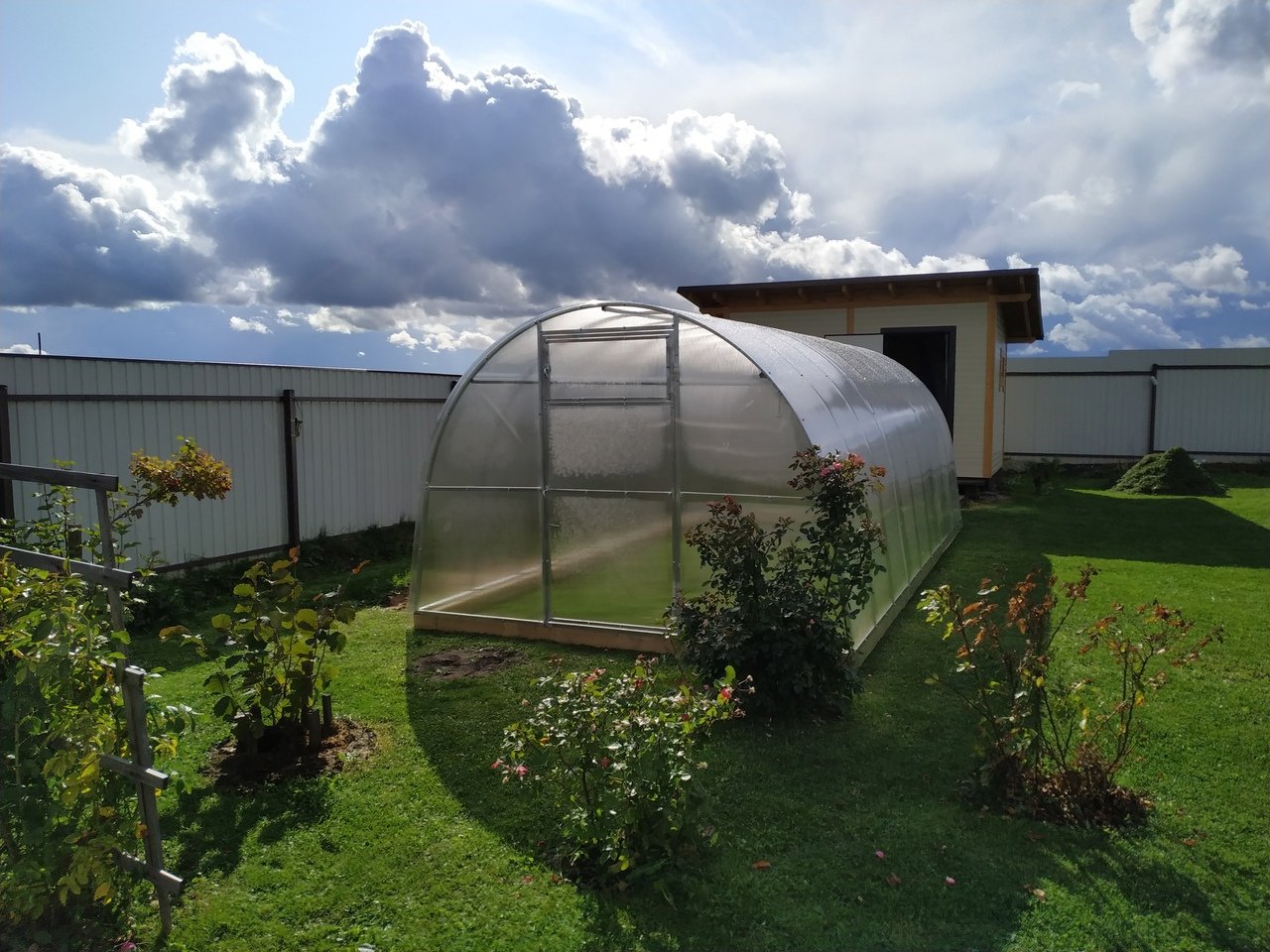
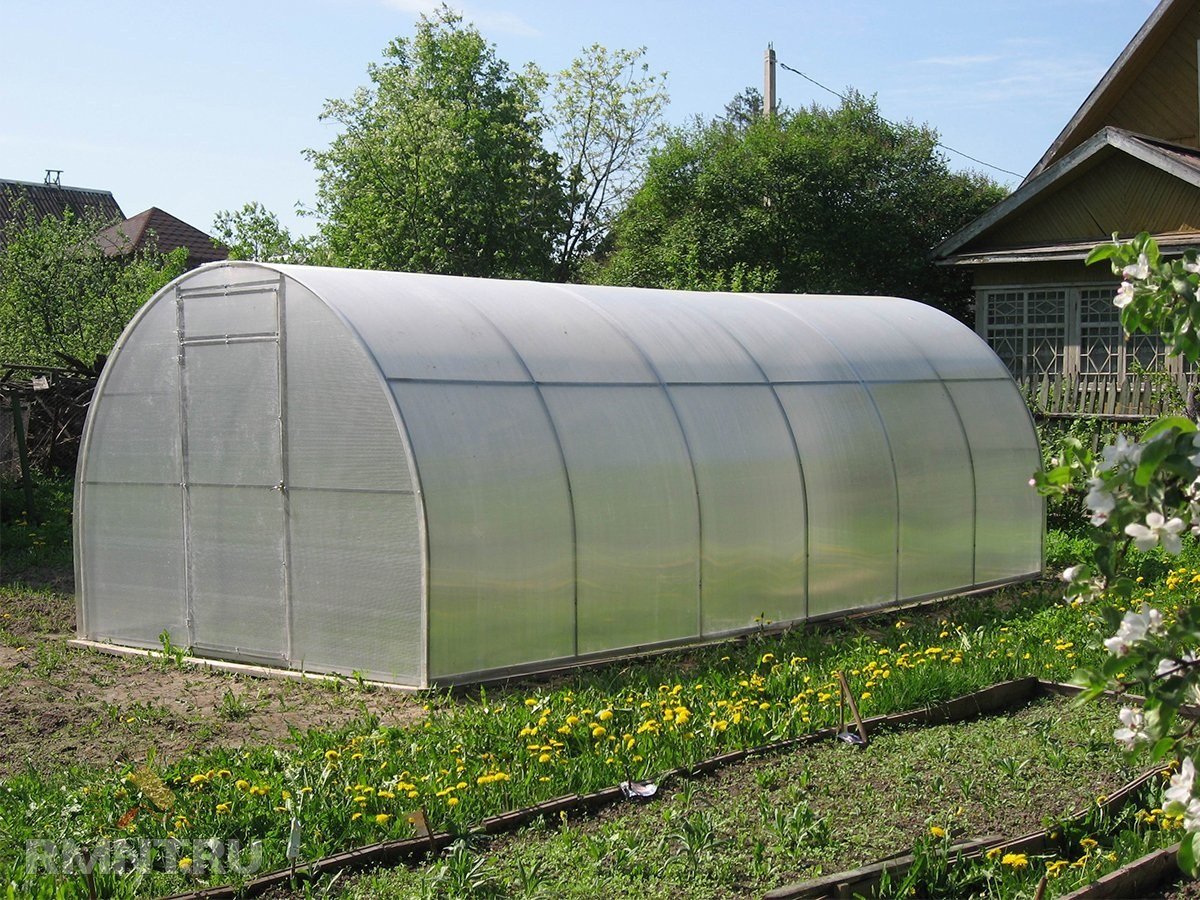
Corners are the weakest point of any greenhouse. However, the shape of the structure directly affects how many corners there will be and how much they will freeze. Let's compare the two most popular forms in Ukraine: the classic gable ("domikom") and arched, which is produced by NovaTeplica.
1. aerodynamics and wind chill
Wind is the main "thief" of heat.
- Gable greenhouse: Flat walls work like a sail. A zone of turbulence forms at the junction of the wall and roof where wind speed increases, creating a rarefaction. This physically "sucks" heat out of gaps and joints.
- Arched (NovaTeplica): It has a streamlined shape. The coefficient of aerodynamic resistance (Cx) of the arch is considerably lower. The wind flows smoothly around the structure without creating zones of sharp pressure difference. Heat losses in a 10 m/s wind at the arch are on 15-20% belowthan their rectangular counterparts.
2. Joints and cold bridges
Every joint is a potential gap.
- In the greenhouse "hut" There are ridge joints (the hottest place where heat escapes) and eave joints (where the gable joins the wall). These are meters of joints that are difficult to seal perfectly.
- In arched greenhouses Polycarbonate sheets are often flipped entirely from ground to ground (over the top). This eliminates horizontal gaps at the top. In NovaTeplitsa constructions we use one-piece arches, which minimizes the number of bolted connections and cold bridges.
3. Condensation problem and moisture in corners
Wet material conducts heat 25 times better than dry air.
- If condensation accumulates in the corner, it wets the frame and polycarbonate, turning them into an ice conductor.
- In rectangular greenhouses, droplets fall downward from the roof or accumulate in the corners of eaves, causing mold.
- In arched structures, condensate flows smoothly down the vault into the ground or drainage due to surface tension, bypassing the working area and not accumulating in "pockets".
Comparison of thermal efficiency of molds
| Characteristic | Arch form (NovaTeplica) | Gable form ("House") |
|---|---|---|
| Surface area | Minimum for the same volume (sphere/cylinder - ideal) | Larger by 10-15% (larger heat transfer area) |
| Air stagnation zones | Just at the base | Wall corners, ridge, cornices |
| Windblown | Streamlined (low losses) | High resistance (high losses) |
| Number of joints | Minimum (solid sheets) | High (ridge, slopes, walls) |
| Snow load | Snow comes off by itself (no pressure on seals) | Snow lies, warping joints and creating gaps |
Engineer's Conclusion: Even with the same insulation, an arched greenhouse will be warmer due to the lack of stagnant pockets and the smaller surface area in contact with the cold wind. This is why we recommend the reinforced tube arch frame series for winter and early winter growing at NovaTeplica.
Why is it always colder in the corners of the greenhouse?: Conclusions
Cold corners are not a judgment call, but an engineering challenge.
- The corners are cooler because of the geometry and lack of air circulation.
- XPS foundation insulation is the most effective step.
- Sealing the joints and using thermal accumulators (water) solves the problem locally.
- The quality of polycarbonate is critical: for an early harvest, choose sheets with a thickness of 6 mm or more and a high density.
Don't let the cold steal your vitamins. A properly designed greenhouse pays for itself not only in the weight of the crop, but also in the peace of mind of the owner.
Ready for a bountiful harvest with no "dead zones"?
If you don't want to experiment with refinishing, tape and foils, and are looking for a reliable solution right away - turn to the professionals.
NovaTeplitsa company offers constructions designed with the climate of Ukraine in mind:
- Frames made of galvanized pipe (corrosion protection).
- Polycarbonate from trusted brands with density guarantee.
- Professional installation, eliminating drafts and gaps.
Get a free engineer's consultation right now! Go to the NovaTeplica catalog - choose a greenhouse with warmth in every corner!






 English
  Русский
  Українська