



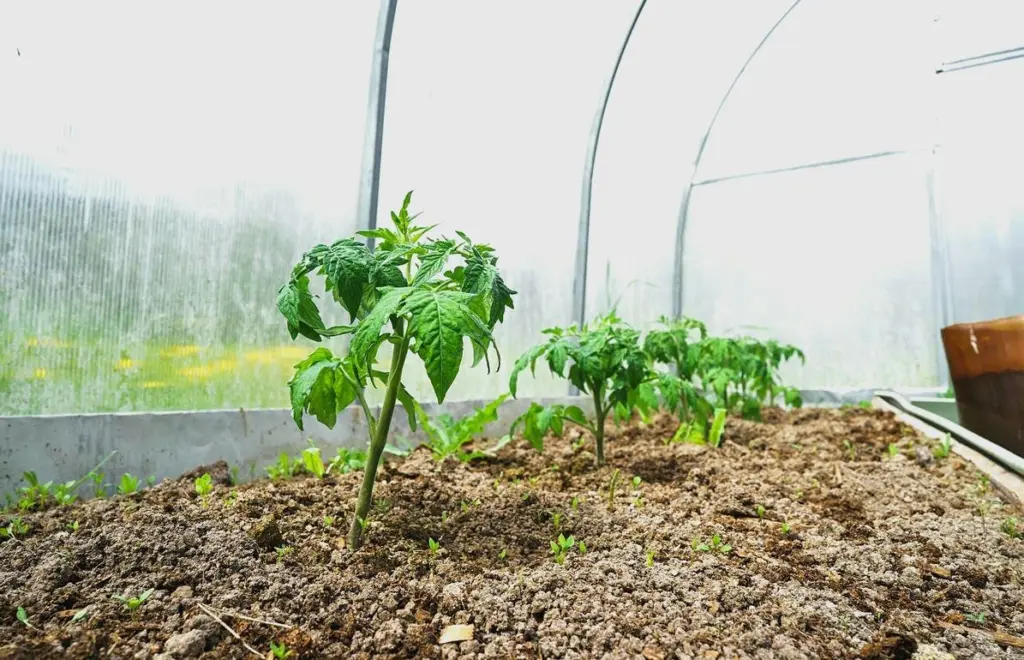
How to Protect Plants in a Greenhouse from Sudden Temperature Fluctuations: An Engineering and Agronomic Approach
A greenhouse should moderate the climate, not intensify it. But in practice, many owners face a paradox: during the day in April, the temperature under the polycarbonate reaches +38 °C, while at night it drops to +4 °C. A daily temperature range of 30 degrees is a stress that neither tomato seedlings nor mature cucumber plants can withstand. The plants drop their flowers, their growth stalls, and the harvest is delayed by two to three weeks.
NovaTeplitsa Company has been manufacturing greenhouses since 1995. Over the past thirty years, we have installed thousands of structures from Odessa to Kharkiv and have seen how the same models behave differently depending on how skillfully the owner manages the microclimate. In this article, we’ve combined thermal engineering, agronomy, and our clients’ practical experience to provide you with a comprehensive guide: why temperature fluctuations are dangerous, how to predict them, and how to protect plants using passive, active, and agronomic methods.
Why Temperature Fluctuations Are More Dangerous Than Just the Cold Itself
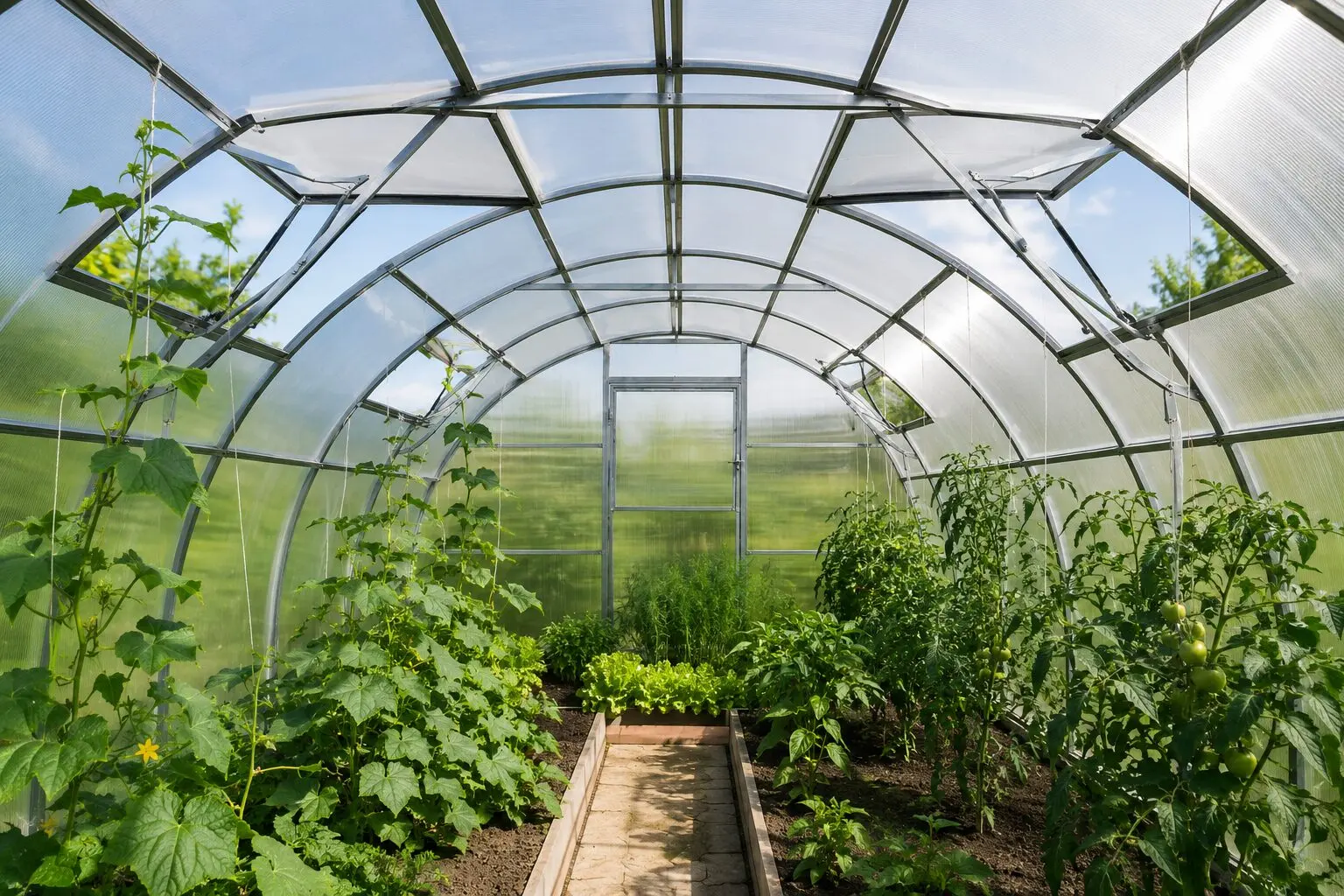
A plant is not a thermostat, but a biochemical system in which the rate of all reactions depends on temperature. The problem with sudden fluctuations lies not in the values themselves, but in the rate of change: the plant cannot adapt its metabolism quickly enough.
What happens physiologically:
- Cold stress (temperatures below +12…+14 °C for heat-loving crops). The roots of tomatoes and cucumbers practically stop absorbing phosphorus and water. The undersides of the leaves turn purple (a sign of phosphorus deficiency even when phosphorus is present in the soil), turgor decreases, and the plant appears «limp.».
- Heat stress (above +32…+35 °C). In tomatoes, pollen becomes sterile as early as +35 °C, and the flowers fall off without forming an ovary. At +35 °C and low humidity, cucumbers shed their ovaries and produce bitter fruit.
- Overnight overheating (above +20…+22 °C at night). The plant «breathes» all night long and uses up the sugars it has stored during the day. The result is watery, tasteless fruit and spindly stems.
- The temperature difference between day and night is more than 12–15 °C. A sharp drop in temperature causes condensation to form on the leaves, and wet leaves at +8…+12 °C provide ideal conditions for late blight, gray mold, and downy mildew.
Comment from a NovaTeplitsa agronomist: «Eight out of ten outbreaks of late blight in private greenhouses that are reported to us do not occur because of «poor-quality» seedlings, but after three or four nights of cold condensation. The plant is weakened by the temperature fluctuation—the fungus enters unopposed.».
Temperature Thresholds for Major Greenhouse Crops
| Culture | Optimum during the day | Optimum at Night | Critical Minimum | Critical Maximum | Safe daily range |
|---|---|---|---|---|---|
| Tomato | +22…+26 °C | +16…+18 °C | +10 °C (growth arrest), +5 °C (damage) | +35 °C (pollen sterility) | up to 8–10 °C |
| Cucumber | +24…+28 °C | +18…+20 °C | +12 °C (roots are dormant) | +35 °C (fruit drop) | up to 6–8 °C |
| Pepper | +24…+28 °C | +18…+20 °C | +13 °C | +32 °C | up to 8 °C |
| Eggplant | +25…+28 °C | +18…+20 °C | +15 °C | +32 °C | up to 8 °C |
| Cabbage, lettuce, greens | +15…+20 °C | +8…+12 °C | −2…−5 °C (briefly) | +28 °C (pointer reading) | up to 12–15 °C |
| Seedlings (General) | +20…+24 °C | +14…+16 °C | +8…+10 °C | +30 °C (stretching) | up to 8 °C |
Take a look at the last column. It is the amplitude—not the absolute numbers—that is the key performance indicator we suggest using to guide your decisions.
Greenhouse Physics: Where Do Temperature Differences Come From?
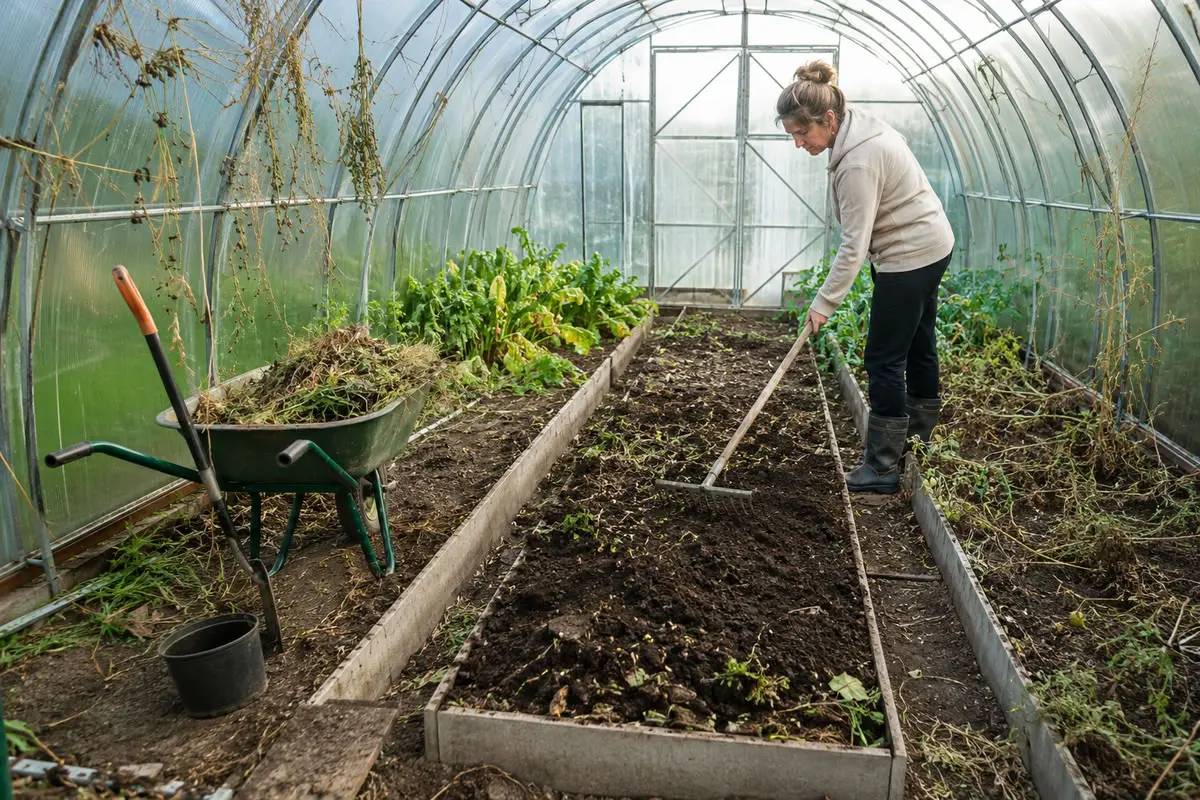
To tackle the problem, you need to understand how it works. Any greenhouse is a trap for solar radiation with very low thermal inertia.
During the day The covering allows short-wave solar radiation to pass through, which heats the soil, plants, and structures. The air inside an enclosed space heats up in 20–40 minutes: on a clear day in April, a 3×6-meter greenhouse without ventilation reaches +35 °C when the outside temperature is +12 °C.
At night The reverse process occurs. The heated surfaces emit heat in the long-wave infrared range; the coating partially transmits this heat, and the air inside cools to outdoor temperature within 1.5–3 hours. Under clear skies and in calm conditions, the effect of radiative cooling is added: the temperature inside a plastic greenhouse may drop below outdoor temperature by 1–2 °C.
How does the coating affect the amplitude?
| Parameter | 100–150 μm film | Double-layer film (with an air gap) | 4 mm polycarbonate | 6–8 mm polycarbonate | Polycarbonate + inner thermal film |
|---|---|---|---|---|---|
| Heat transfer coefficient (guideline) | ~6.0–6.5 W/m²·K | ~3.5–4.0 W/m²·K | ~3.9 W/m²·K | ~3.3–3.6 W/m²·K | ~2.3–2.8 W/m²·K |
| The difference between «inside» and "outside" at night without heating | 0…+2 °C | +2…+4 °C | +2…+3 °C | +3…+5 °C | +5…+7 °C |
| Cooling rate after sunset | Tall | Average | Average | Low | Low |
| Overheating During the Day | Strong | Strong | Strong | Moderate (some IR is scattered) | Moderate |
| Condensation on plants | Heavy | Moderate | Moderate | Weak | Minimum |
| Recommended Scenario | Season: April–October | Early spring, late fall | Summer at the Cottage | Extended season, March–November | Year-round with minimal heating |
The conclusion we share with every customer is this: the thickness of the polycarbonate and the second layer of coating reduce the amplitude by a factor of 1.5 to 2 without costing a single kopeck in energy. That is precisely why our «Ideal» models are designed with Models with polycarbonate 4, 6, and 8 mm, as well as a combination type version with an inner thermal film, which creates an additional air layer.
Step 1. Measure, Don't Guess
Without data, you're fighting a losing battle. The minimum set of controls:
- Thermometer with high and low readings (mechanical or electronic) — one per greenhouse. Install it at the height of the plants (30–60 cm above the ground for seedlings, 1–1.5 m for mature tomato plants), in the shade, away from walls and vents.
- Soil Thermometer At a depth of 10 cm, the roots respond to soil temperature rather than air temperature. Tomatoes should not be planted when the soil temperature is below +14 °C, and cucumbers should not be planted when it is below +16 °C.
- Hygrometer — because a temperature difference is destructive at 90% humidity, but tolerable at 60%.
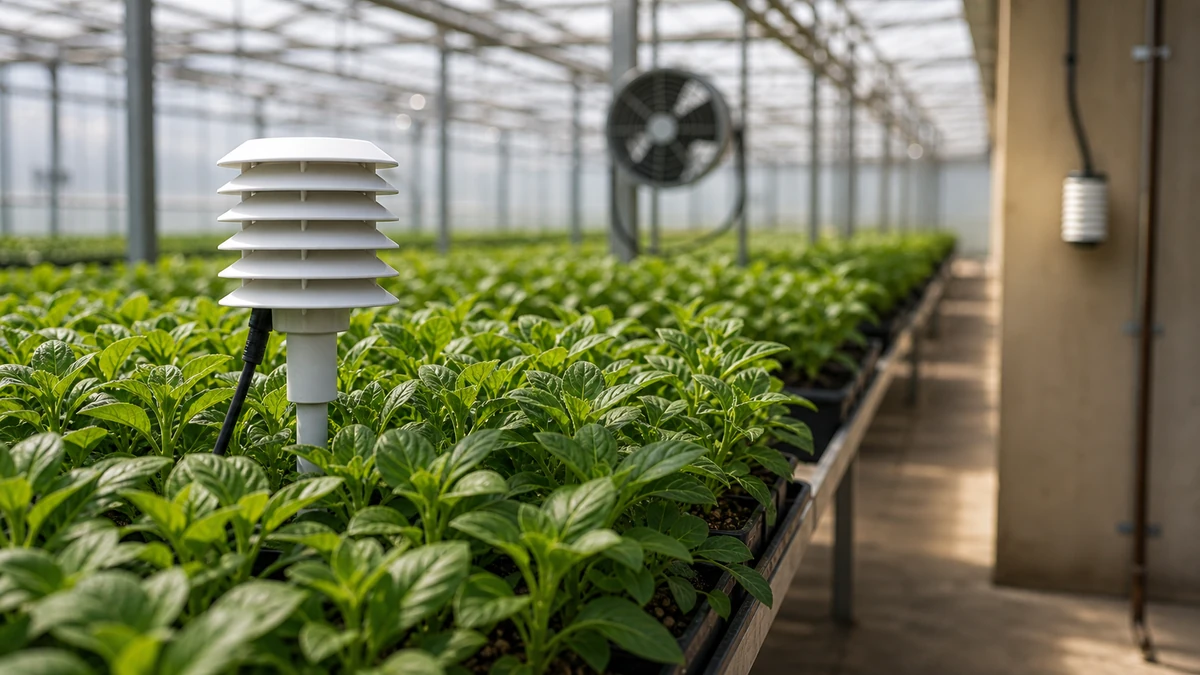
- Outdoor Sensor — to understand what level of protection the coating actually provides.
Electronic weather stations with two or three wireless sensors currently cost between 600 and 900 UAH and pay for themselves with just one batch of seedlings saved. Record the daily minimum and maximum temperatures for at least two weeks in the spring—you’ll be surprised at how much the actual temperature range differs from what you’d expect.
Step 2. Passive Protection—The Foundation of Stability
Passive methods don't consume energy, work around the clock, and never break down. That's exactly where you should start.
Heat Storage Units
The most underrated tool. Water has a heat capacity of 4.18 kJ/kg·K—four times higher than that of air and nearly five times higher than that of concrete. During the day, the storage system absorbs excess heat (reducing overheating), and at night, it releases it (reducing cooling).
Practical options:
- Barrels of water. Dark plastic containers holding 100–200 liters are placed along the north wall. A 3×6-meter greenhouse requires 400–600 liters of water to keep the nighttime temperature 2–3 °C higher than it would be without a thermal storage system.
- PET water bottles Along the garden beds and between the plants—it's inexpensive but effective for seedlings.
- A stone or brick path In the center: it accumulates up to 300–500 kJ/m² during the day and slowly releases the energy at night.
- Dark mulch or black agricultural fabric in garden beds — increases the soil's absorption of solar radiation, which is critical for early plantings.
Calculation by a NovaTeplitsa engineer: «Every 100 liters of water that cools by 10 °C overnight releases about 4,200 kJ—that’s roughly 1.2 kWh of heat. Six 200-liter barrels in a 3×6-meter greenhouse function like a 1.5-kW electric heater left on for 8–10 hours. For free, every night.».
Second perimeter: interior shelter
An air gap is the best insulator available to a greenhouse owner.
| Method | Increase in nighttime temperature | Costs | When to Use It |
|---|---|---|---|
| Agricultural fiber, 17–30 g/m², applied directly to the plants | +1.5…+3 °C | Minimum | Nighttime frosts, brief cold spells |
| Arches + agricultural fabric (42–60 g/m²) over the garden bed («greenhouse within a greenhouse») | +3…+5 °C | Low | Early seedlings, March–April |
| Internal thermal insulation film covering the entire interior | +4…+7 °C | Average (one-time) | Extending the season by 1–1.5 months on each side |
| Bubble wrap on the north wall | +1…+2 °C | Low | An Addition to Any Method |
A rule that many people break: the agricultural fabric should not touch the leaves when it freezes. Moisture from the fabric transfers the cold directly to the leaves. Use arches or at least stakes.
Heated Beds and Deep Planting
A raised bed 30–40 cm high, with organic «biofuel» (manure, compost, plant debris) in the bottom layer, releases heat as it decomposes over the course of 4–8 weeks. The soil temperature remains 5–8 °C higher than in a conventional garden bed, which is more important for the roots than the air temperature. Sunken greenhouses (with the floor 50–80 cm below ground level) take advantage of the stable soil temperature but require drainage and are not suitable for all plots.
Proper orientation and wind protection
Wind is the main «thief» of heat. At a speed of 5 m/s, heat loss through gaps increases 2–3 times, and the structure cools down faster on the windward side. Orient the greenhouse so that the ridge runs east to west (for spring and fall use) or north to south (for summer use), and place a fence, hedge, or outbuilding 3–5 m away on the windward side.
Step 3. Protection Against Nighttime Cold — Active Methods
When passive measures aren't enough (early planting, late frosts in May, extending the growing season into November), heating is turned on. Let's compare the options for a summer cottage and a small farm greenhouse.
| Heat source | Power / 3×6 m greenhouse | Cost of 1 kWh of heat (estimate, 2026) | Pros | Cons |
|---|---|---|---|---|
| Electric Convection Heater | 1.5–2 kW | ~4.3–5 UAH | A precise thermostat—it's that simple | Expensive over the long term; relies on the power grid |
| Infrared heater (IR panel, film) | 1–1.5 kW | ~4.3–5 UAH | It heats the soil and plants, not the air; it doesn't dry them out; it's 20–30% more economical | Must be placed correctly (no closer than 1.5 m to plants) |
| Heating cable in the ground | 60–100 W/m² of garden bed | ~4.3–5 UAH | Perfect for seedlings—the roots are always kept warm | For soil only; it doesn't heat the air |
| Solid-fuel stove / Buleryan stove | 3–6 kW | ~1.5–2.5 UAH (firewood) | Autonomy, affordable | No automatic system; nighttime monitoring is required; chimney |
| Gas Infrared Heater (Cylinder) | 2–4 kW | ~3–4 UAH | Standalone, mobile | Emits CO₂ and moisture—ventilation is required |
| «Stove-style» candles made from pots, paraffin candles | 0.1–0.3 kW | Kopeikas | A backup plan for one or two nights | It adds +1…+2 °C, no more |
| Water-based heating from a boiler | According to the calculation | It depends on the fuel | Consistently, evenly | Installation is expensive, but justified for areas of 50–100 m² |
How to Calculate the Required Power. A simplified formula for a private greenhouse:
P (W) = S (m²) × k (W/m²·K) × ΔT (°C) × 1.2
where S is the roof area (for a 3×6×2.2 m greenhouse, this is approximately 55 m²), k is the heat transfer coefficient of the covering from the table above, ΔT is the difference between the desired indoor temperature and the expected outdoor temperature, and 1.2 is a margin for heat loss through gaps and vents.
Example: 6 mm polycarbonate (k ≈ 3.5); outdoor temperature at night is +2 °C; target temperature is +12 °C: 55 × 3.5 × 10 × 1.2 = 2,310 W. For the same greenhouse with thermal film (k ≈ 2.5), 1,650 W would be required—almost 30% less. This is how savings on insulation translate into energy savings.
An important rule for placement: Place the heater at the coldest spot (usually near the end with the door or on the north side), not in the center; otherwise, the warm air will rise, and the plants will be left in a cold «pool» near the floor. A small circulation fan (20–40 W) evens out the temperature difference between the floor and the ceiling, which can reach 6–8 °C without it.
Step 4. Protection Against Overheating During the Day
Overheating kills just as many plants as cold does, but people tend to think about it less often. Three strategies: ventilation, shading, and evaporative cooling.
Ventilation: Main Control Valve
For a greenhouse, the area of the opening vents should be 15–25% of the floor area. For a 3×6 m (18 m²) greenhouse, this amounts to 2.7–4.5 m²—that is, two or three roof vents plus doors at both ends. One door is not enough: without a through draft, the air will not circulate.
How it works: Warm air rises to the roof ridge—roof vents let it out, while cold air enters through the doors and side openings. The 1.5–2-meter difference in height creates natural draft without the need for fans.
Automatic Ventilation System — the only investment we consider essential. A hydraulic thermal actuator (a cylinder containing a heat-sensitive compound) opens the vent at +23…+25 °C and closes it as the temperature drops. It requires no electricity, lasts 10–15 years, costs 1,200–2,500 UAH, and solves the owner’s main problem: you can’t be in the greenhouse at 11 a.m. on a weekday, but that’s exactly when overheating begins.
Case Study: NovaTeplitsa (Kyiv Oblast, «Ideal» Greenhouse, 4×8 m): «The first year, I opened the vents by hand. I’d leave for work at 7 a.m. when it was +15 °C, and at lunchtime my wife would call: it was +40 °C in the greenhouse, and the cucumbers were wilting. I installed three thermal actuators—the daily temperature range dropped from 25 to 10 degrees, and the buds stopped falling off.».
Shading
When the ventilation system can't keep up (July, +33 °C outside), you need to reduce the amount of heat coming in:
- Shade Net 40–60% When placed on the outside of the covering, it lowers the temperature inside by 5–8 °C. It is attached to the frame from above and removed in August.
- Chalk slurry (1 kg of chalk per 10 liters of water) is applied with a sprayer to the outside of the polycarbonate and is washed away by rain by fall. It's inexpensive, but the coverage is uneven.
- Internal reflective (aluminum-coated) shutter — It's more expensive, but it's adjustable.
Never apply paint or use a thick fabric on polycarbonate: overheating the material under a layer that blocks ventilation will cause it to warp, and this is not covered by any manufacturer's warranty.
Evaporative cooling
Watering paths and walls at noon draws heat away through evaporation (about 2,260 kJ per liter). In dry, hot weather, this lowers the temperature by 3–5 °C but increases humidity—use this method only with windows slightly open; otherwise, you’ll end up with a sauna-like environment and health problems.
Step 5. Agricultural Techniques: How to Make a Plant More Resistant to Temperature Fluctuations
Even a perfect greenhouse can't override biology. Here's what the owner should do.
Hardening Off Seedlings. 10–14 days before transplanting, lower the nighttime temperature to +12…+14 °C and take the seedlings outside for 2–4 hours a day. Hardened seedlings can tolerate a temperature difference of 15 °C without stunted growth, while unhardened seedlings will die at 8 °C.
Water only with warm water, and only in the morning. Water temperature: +18…+22 °C. Watering with cold water (from a well at +8 °C) is a shock to the roots, just like freezing. Watering in the evening on a cold night is a surefire way to cause condensation and fungal growth.
Anti-stress feed supplements before an expected temperature drop:
- Potassium fertilizers (monopotassium phosphate, 10–15 g per 10 L, applied as a foliar spray) increase the concentration of cell sap, lowering the freezing point and improving heat tolerance.
- Silicon-containing supplements strengthen cell walls.
- Amino acid and humic acid stimulants 1–2 days before the temperature drops.
- Do not apply nitrogen Before the cold weather sets in: it stimulates the growth of delicate tissues, which are the first to be affected.
Mulching A 5–8 cm layer of straw, mowed grass, or agricultural fiber stabilizes the temperature in the root zone: daily temperature fluctuations are reduced from 10–12 °C to 3–4 °C.
Planting density. Crowded plants do not get enough air, and damp, cold air accumulates between them. Follow this planting guide: 3–4 indeterminate tomato plants per square meter, and 2.5–3 cucumber plants per square meter.
Seasonal Plan for Protection Against Volatility
| Period | The Main Threat | What to Do |
|---|---|---|
| March–mid-April | Nighttime frosts down to −5 °C, daytime temperatures up to +30 °C | Internal heating loop (thermal film or arcs with agrotextile), heat storage units, nighttime heating, automatic ventilation during the day |
| Mid-April through May | Recurring frosts, with a temperature range of 20+ °C | Agricultural fabric ready to go, batteries, watering in the morning, potassium fertilizer application before the cold snap |
| June–August | Overheating at +40 °C, nighttime heat | Shade net, all vents and doors open, evaporative cooling, mulch |
| September–October | Cold nights of +3…+5 °C with condensation, warm days | Reduce watering, ventilate during the day, cover at night, and provide heat if the forecast calls for temperatures below +5 °C |
| November–February (during winter operation) | Constant cold, very little light | Dual-circuit coating, water-based or IR heating with a thermostat, supplemental lighting, humidity control |
Five Common Mistakes We See Most Often
- Close the greenhouse tightly «to keep the heat in.». Without ventilation during the day, the plants overheat, and at night they are drenched in condensation. You need to open the windows even in March.
- The heater is in the center, under the ridge. Heat rises, so the roots get cold. Place it near the cold end, low to the ground, with a circulation pump.
- Thick polycarbonate with unsealed ends. Open cells collect condensation and dirt, and thermal insulation is reduced by half. End profiles and perforated tape are required.
- Ignoring soil temperature. The air temperature is +20 °C, and the soil temperature is +10 °C—the plant is thriving. A soil thermometer costs 100 UAH.
- Suddenly removing the cover on a warm day. A plant growing under agrotextile has become accustomed to a mild climate; uncover it gradually, on a cloudy day or in the evening.
How We Design Greenhouses to Account for Temperature Fluctuations
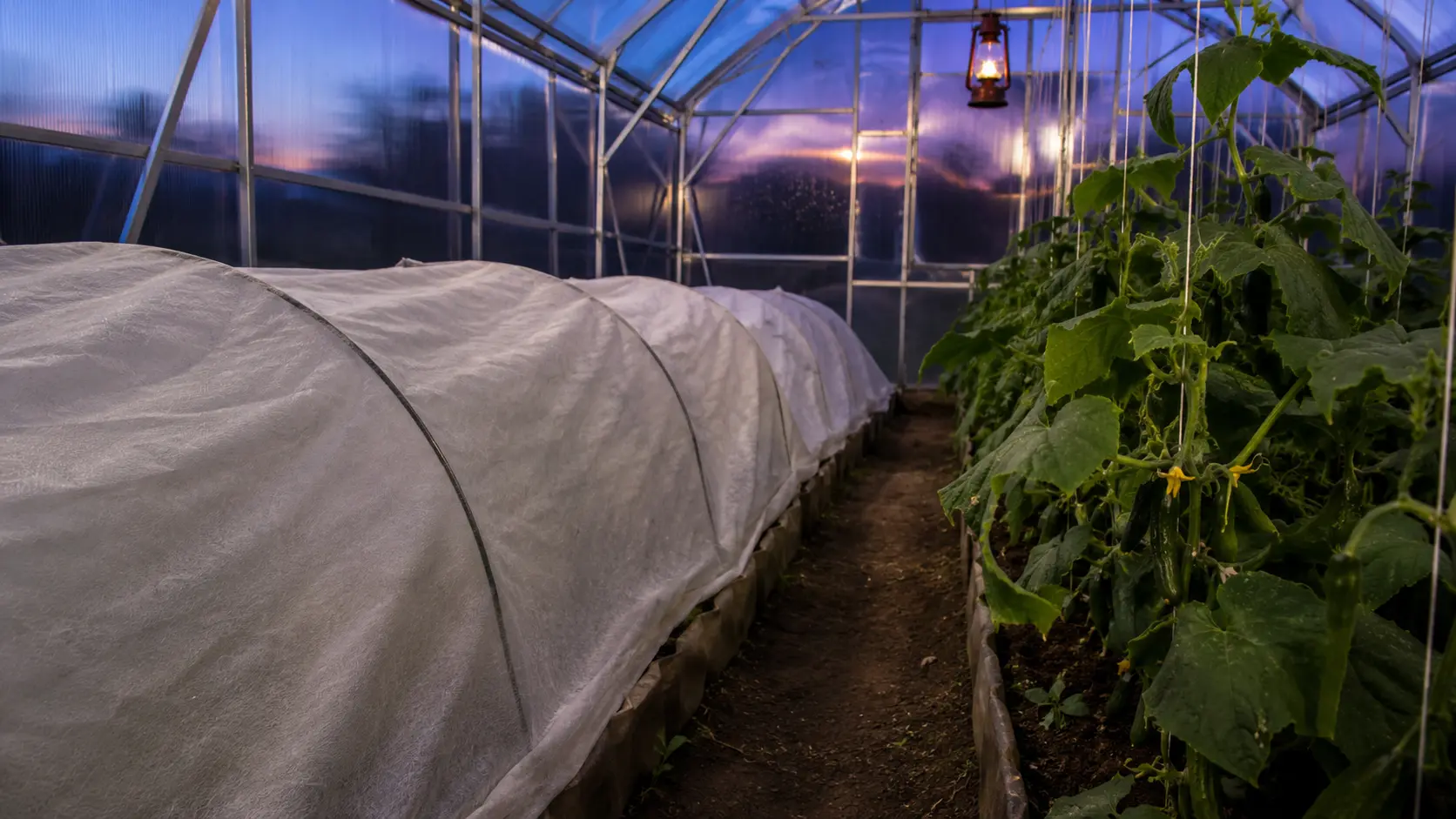
A stable microclimate is established during the design phase—after that, it can only be adjusted. NovaTeplitsa models include the following features for this purpose:
- A frame made of galvanized steel profiles with an arch spacing of 1 m, which can support the weight of the shade screens, the inner thermal film, additional equipment, and snow loads.
- Skylights in the roof and gables In the standard configuration, with the option to install thermal actuators, the ventilation area is calculated based on the standard of 15–25% of floor area.
- Choosing the Right Coating for the Job: 4 mm polycarbonate for a seasonal garden greenhouse, 6–8 mm for an extended growing season, a combined option «polycarbonate + inner thermal film»for year-round cultivation with minimal heating costs.".
- Double doors at the ends for cross-ventilation.
- Option to install on a foundation — The depth of the hole and the foundation beam reduce airflow through the lower zone, where the roots are located.
We offer a 10-year warranty on the frame and covering because we know how the structure performs at −25 °C in the winter and +45 °C in the summer under the polycarbonate roofing.
Frequently asked questions
At what outdoor temperature will an unheated greenhouse protect tomatoes? 6-mm polycarbonate with heat accumulators maintains a temperature of +3…+5 °C compared to the outside. This means that when the outdoor temperature is up to +5…+7 °C, the plants are safe; at 0…+3 °C, additional protection with agrotextile is needed; and below 0 °C, heating is required.
Which is better for withstanding temperature fluctuations: thick polycarbonate or double-layer film? In terms of thermal insulation, they are similar, but polycarbonate lasts 10–15 years and does not accumulate condensation as much. Double-layer plastic sheeting is cheaper initially and is a good choice for large, seasonal farm greenhouses.
Does regular bottled water actually help, or is that just a myth? It helps, but the scale matters: 10 bottles of 1.5 liters each equals 15 kg of water, so the effect is negligible. For a 3×6-meter greenhouse, you need 300–400 liters to raise the temperature by +2…+3 °C at night.
Do you need a fan in a small greenhouse? For a 18 m² space, properly placed vents are sufficient. A circulation fan becomes useful for spaces of 25–30 m² or larger, or when the space is being heated: it evens out the temperature between the floor and the ceiling.
Is it possible to save the plants if the temperature fluctuation has already occurred? Yes, if you act immediately: water it with warm water in the morning, treat the leaves with potassium or an amino acid stimulant, keep it out of direct sunlight for 2–3 days, avoid feeding it nitrogen, and remove any damaged leaves. Recovery takes 7–10 days.
Protecting Greenhouse Plants from Sudden Temperature Fluctuations: Conclusion
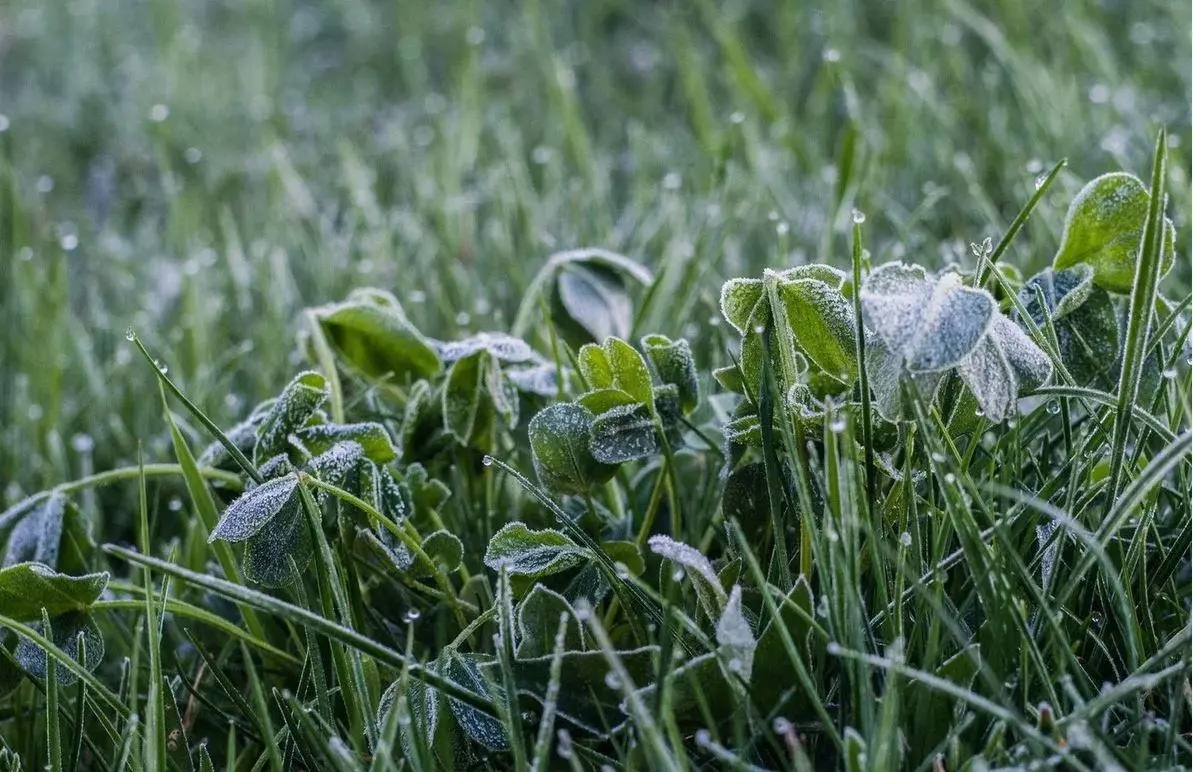
Protection against temperature fluctuations is not a single device, but a three-tiered system: the greenhouse structure (covering, vents, foundation), passive heat storage and coverings, and only then—active heating with automation. Each level reduces the temperature range by a factor of 1.5 to 2 and makes the next level more cost-effective. A plant that thrives within an 8–10 °C range between day and night yields a harvest 2–3 weeks earlier and 20–30% more than one that experiences a 25-degree temperature shock every day.
If you're planning to build a greenhouse or want to upgrade an existing one with a ventilation system and an internal circulation loop, NovaTeplitsa's engineers will help you choose a configuration tailored to your region and crops.