



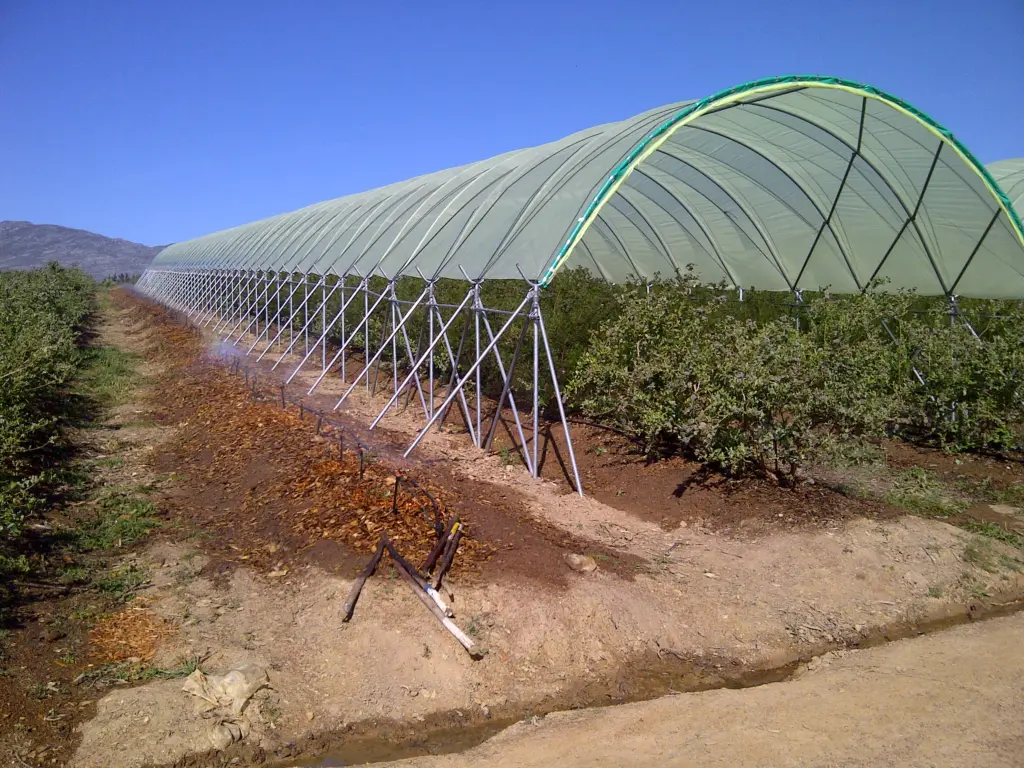
How to Protect a Greenhouse from Hail: Materials, Hail-Proof Netting, Construction, and What to Do After a Hailstorm
There are three ways to protect a greenhouse from hail: by choosing an impact-resistant covering (6-mm cellular polycarbonate with UV protection can withstand hailstones up to 3–4 cm in diameter, while plastic sheeting tears at just 1.5–2 cm), a hail-resistant net over the roof, which absorbs the energy of hailstones of any size; and proper installation—a sheet secured with improper spacing and without an end profile will shatter where a single, intact sheet would flex. The fourth level is organizational: forecasting, temporary shelter, and insurance.
NovaTeplitsa has been manufacturing greenhouses since 1995, and every summer, after hailstorms in the Kyiv, Vinnytsia, Khmelnytskyi, and Cherkasy regions come to us with the same types of damage: torn plastic sheeting, punctured thin polycarbonate, and cracked panels at the fasteners. In this article, we’ll examine what hail is and why it’s dangerous, how different coverings behave, how to select and install anti-hail netting, what installation mistakes turn hail into a disaster, and what to do in the first few hours after a hailstorm.
What Types of Hail Are There, and How Much Energy Do They Carry?
The danger posed by hail is determined not by the number of hailstones, but by their size and rate of descent. A hailstone with a diameter of 2 cm falls at a speed of about 20 m/s, one with a diameter of 4 cm at 30 m/s, and one with a diameter of 6 cm at 40 m/s; kinetic energy increases in proportion to mass and the square of the speed.
| Hailstone Size | Comparison | Fall Speed | Impact Energy | What causes damage |
|---|---|---|---|---|
| Up to 1 cm | Peas | 10–15 m/s | Up to 0.05 J | No greenhouse coverings; leaves from plants grown in open ground |
| 1.5–2 cm | Hazelnut | 18–22 m/s | 0.3–0.8 J | 100–120-micron film; old film of any thickness |
| 2.5–3 cm | Walnut | 24–28 m/s | 2–4 J | 150–200 μm film, 4 mm polycarbonate without a UV coating, or over 5 years old |
| 4 cm | Chicken egg | 30–34 m/s | 8–12 J | 4 mm polycarbonate, 6 mm if installed improperly, 4 mm glass |
| 5–6 cm | Tennis ball | 36–42 m/s | 20–40 J | 6–8 mm polycarbonate, glass of any thickness |
| 7 cm or more | Rarely, 1–2 times per decade per region | 45+ m/s | 60+ J | Everything except 10-mm polycarbonate under the mesh and solid polycarbonate |
In Ukraine, hail with hailstones measuring 2–4 cm is an annual occurrence in the central and western regions from May through August; 5–6 cm — once every few years in Vinnytsia, Khmelnytskyi, Ternopil, Cherkasy, and Kirovohrad regions; in the south and east, hail is less frequent but more intense. The most dangerous situations are not caused by isolated large hailstones, but by 10–20 minutes of heavy hail measuring 2–3 cm accompanied by winds of 15–20 m/s: the hail strikes walls at an angle, and the wind amplifies the impact.
Comment from a NovaTeplitsa engineer: «People ask, «Will your polycarbonate withstand hail?» The right question is, «What kind of hail?»" 6-mm polycarbonate on our frame can withstand 4 cm of hail without damage—we’ve tested this both on a test bench and in real-world warranty cases. No cellular polycarbonate roofing you can afford can withstand 6 cm of hail.” a summer cottage greenhouse. ». That's why protecting a greenhouse from hail always involves using a cover plus netting if you're in a hail-prone region.".
How Do Roof Coverings Hold Up During a Hailstorm?
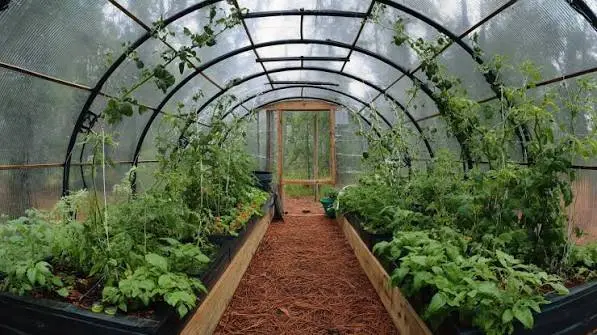
Film
A 100–150-micrometer polyethylene film is the most vulnerable covering. A 2-centimeter hailstone can puncture it or leave a tear that the wind can turn into a one-meter hole in a matter of minutes. Reinforced film holds up better: tears are contained within the reinforcement grid, and the roof does not «come apart.» A 150–200-micrometer multilayer film with UV stabilization can withstand 2–2.5 cm of hail when properly tensioned; a sagging film will tear from even smaller hailstones.
The main advantage of the film is that it’s easy to repair: adhesive tape and a patch cost 50 hryvnia, while completely re-covering a 3×6-meter greenhouse costs 2,000–4,000 hryvnia.
Cellular polycarbonate
The impact resistance of polycarbonate is 200 times greater than that of glass and 8–10 times greater than that of acrylic. However, with multiwall polycarbonate, there are three factors that determine whether hail will penetrate it or not:
- Thickness and structure. 4 mm — two walls, crossbars spaced 6 mm apart; 6 mm — same as above, but with thicker walls; 8 and 10 mm — often three walls or a reinforced structure. Each increase in thickness adds approximately +40–60% to impact resistance.
- UV protection. A sheet without a co-extruded UV layer becomes brittle within 2–3 seasons: ultraviolet radiation breaks down the polymer chains, and polycarbonate that previously maintained a thickness of 4 cm begins to crack at 2 cm. Sheets with a UV layer retain 80–90% of their impact resistance for 10 years or more.
- Age and Density. «Lightweight» 4-mm polycarbonate with a density of 0.5–0.6 kg/m² instead of the standard 0.8 kg/m²—its thin walls can be punctured 2–3 cm deep. It’s easy to tell the difference: the sheet bends with a crunch when squeezed by hand, and the wall thickness at the cut edge is less than 0.2 mm.
Hail damage to polycarbonate isn't limited to holes that go all the way through. More often, it takes the form of microcracks around the point of impact—cracks that aren't visible but spread over the course of six months due to temperature fluctuations, causing water to seep into the cells of the sheet.
Glass
4-mm glass shatters when hit by 3–4-cm hailstones; 5–6-mm tempered glass can withstand 4–5-cm hailstones, but it is expensive and heavy. Glass shards in a greenhouse pose a separate risk. We do not recommend glass for regions prone to hail.
| Coating | Withstands without damage | The damage begins | Repairs After a Hailstorm | Length of service in the Hradec region |
|---|---|---|---|---|
| 100–120 µm film | up to 1 cm | 1.5 cm | Patch: 50–200 UAH; reupholstering: 2,000–4,000 UAH | Seasons 1–2 |
| Reinforced film, 200 micrometers | up to 2 cm | 2.5–3 cm | Patch, re-tensioning: 4,000–6,000 UAH | 3–5 seasons |
| 4 mm polycarbonate with UV protection | up to 2.5–3 cm | 3.5–4 cm | Replacement of a 2.1×6 m sheet — 1,500–2,500 UAH + installation | 8–10 years |
| 4 mm polycarbonate without UV protection or «lightweight» | up to 1.5–2 cm | 2.5 cm in 2–3 seasons | Replacing a sheet | 2–4 years |
| 6 mm polycarbonate with UV protection | up to 4 cm | 5 cm | Panel replacement: 2,500–3,500 UAH | 10–15 years |
| 8–10 mm polycarbonate with UV protection | up to 5 cm | 6 cm or more | Panel replacement: 3,500–6,000 UAH | 15+ years |
| Solid polycarbonate, 3–4 mm thick | virtually any hail | — | — | 15+ years; 4–6 times more expensive than a cell phone |
| 4 mm glass | up to 2.5 cm | 3–4 cm | Replacement, fragments | — |
| Any type of covering under the hail protection net | any hail | — | Replace the screen every 5–8 years | Coverage Period × 1.5 |
At «Ideal» Greenhouses, we offer 4-, 6-, and 8-mm polycarbonate, and for the Vinnytsia, Khmelnytskyi, Cherkasy, and Ternopil regions, we recommend a thickness of at least 6 mm—not only to protect against hail, but also to withstand snow loads and provide thermal insulation. The combined option of «polycarbonate on the roof, plastic film on the walls» also works well in hail-prone regions: hail strikes the roof, while the walls are only damaged by strong winds.
Hail protection netting: the only defense against any kind of hail
An anti-hail net is a polyethylene net with 7–10 mm mesh, stretched over the greenhouse roof with a gap. Hailstones strike the netting, lose energy as they stretch the threads, and either remain on the netting or roll off toward the edge. The covering beneath the netting absorbs 10–20% of impact energy—which is safe even for plastic film.
How to Choose a Net
| Parameter | Recommendation | Why |
|---|---|---|
| Material | HDPE (high-density polyethylene) with a UV stabilizer | Without a UV additive, the netting will fall apart within 2–3 seasons |
| Density | 50–90 g/m²; for 2–4 cm — 50–60, for 5+ cm — 80–90 | Density determines the strength of the thread |
| Cell | 7×7 … 10×10 mm | Less — more shading; more — small hailstones get through |
| Color | Clear (crystal), white, light gray | Black and green provide 20–30% of shading |
| Shading | 8–15% for clear and white | Suitable for tomatoes, cucumbers, and peppers; it’s even beneficial for herbs in the summer |
| Service life | 5–8 years with UV stabilization | Burnout and Wind Fatigue |
| Price | 25–60 UAH/m² for the mesh, 100–200 UAH/m² including the frame and installation | — |
For a 3×6-meter greenhouse, the roof coverage area with an overlap is about 25–30 m²; the netting will cost 1,000–2,000 UAH, and with a tension frame, 3,000–6,000 UAH.
How to Install a Hail Protection Net
The main mistake is to place the mesh directly on the polycarbonate. When hail hits the mesh lying on the sheet, it transfers the impact to the sheet almost entirely. You need a gap.
- Tension frame. Above the greenhouse arches, on posts made of galvanized profile or on external brackets, a second support structure is created 15–30 cm above the roof. On NovaTeplitsa greenhouses, the frame—with arches spaced 1 m apart—can withstand an additional load: 25–30 m² of netting with hail on it—up to 30–50 kg.
- Tension. The mesh is stretched evenly, with no sagging greater than 5–8 cm across the span; sagging mesh comes into contact with the sheet upon impact. It is secured—via eyelets or an edge cord—to a cable or wire stretched between the posts, with springs or turnbuckles for tensioning.
- Overhang. The netting extends 30–50 cm beyond the edge of the roof on each side and runs down the walls to a height of 1–1.2 m: hail driven by the wind strikes the wall at an angle.
- Slope. The mesh should slope toward the edge so that hail and water roll off rather than accumulate.
- Seasonality. In regions with one or two months of hail, the netting can be removed for the winter—snow on the netting above the greenhouse is more dangerous than hail. In greenhouses where the netting remains in place year-round, the support frame is designed to withstand the region’s snow load.
Comment from a NovaTeplitsa engineer: «A properly tensioned net 15–20 cm above the polycarbonate sheet marks the transition from «withstands up to 4 cm» to «withstands anything.» We installed the net above the plastic sheeting farm greenhouses In the Vinnytsia region, following the 2023 hailstorm that tore 600 m² of plastic sheeting there; since then—two hailstorms, zero damage. »The frame for the netting costs 15–20% of the covering’s price, yet it protects the covering for its entire service life.”.
A Shade Net as a Compromise
The 40–60% shade net is a different product: it protects against overheating but only partially against hail. Its 2–4 mm mesh is denser, the threads are thinner, and it’s less durable; hailstones 3–4 cm in diameter will tear it. If you install the shade net in the summer, make sure it has a 15–20 cm gap and is UV-stabilized—then it will provide both shade and protection for the greenhouse against hail up to 2.5–3 cm in diameter. For hail-prone regions, it’s better to use two nets: a permanent hail-protection net and a shading net in July.
Design and Installation: Where Hail Strikes the Greenhouse
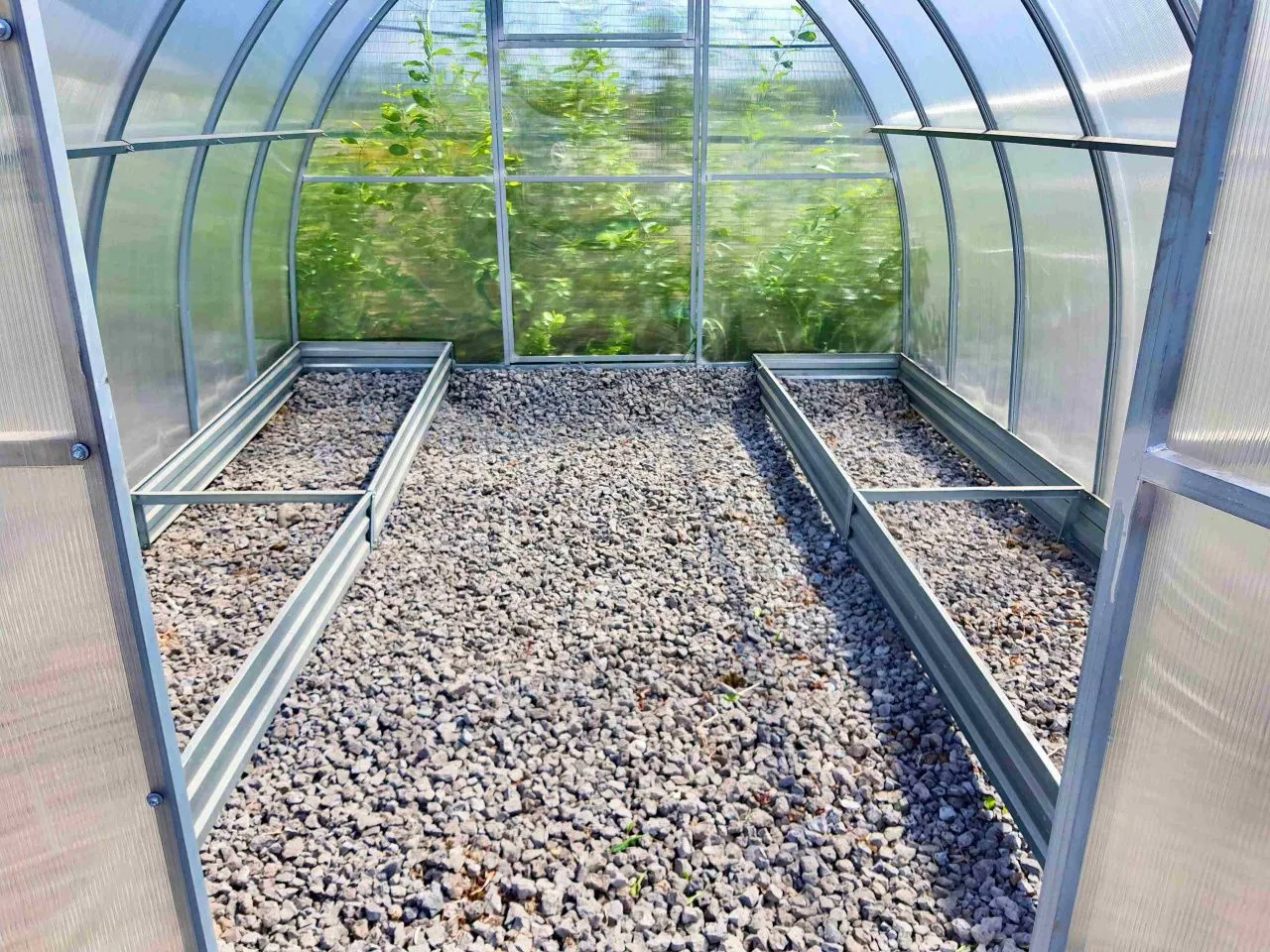
Hail doesn't damage «polycarbonate in general,» but rather specific weak spots. Most of these are caused by the installation.
| Weak spot | What Happens During a Hailstorm | How to Do It Right |
|---|---|---|
| The sheet is screwed in place with self-tapping screws without thermal washers, securely | There's no room for expansion; the sheet is under tension, and the impact-induced crack originates from the self-tapping screw | Heat-resistant washers or roofing screws with an EPDM washer; the hole is 2–3 mm larger than the diameter |
| The self-tapping screws are overtightened, and the sheet metal is dented | Stress Concentration at Fastening Points | Pull back until the puck is touched, without pushing through the wall |
| Overlapping sheet joints, without a connecting profile | The unsupported edge of the sheet breaks on impact, and water enters the honeycomb structure | Detachable or non-detachable H-profile; the sheet extends 20 mm with a gap |
| Open ends of the honeycomb | Water and dirt in the honeycomb; the sheet loses its elasticity and becomes cloudy | Edge profile and perforated strip on the bottom, sealing strip on top |
| The sheet is bent against the stiffeners or has a radius smaller than the allowable value | Internal tensions; hail is the final blow | Honeycomb panels along an arc, with a bending radius of at least 150 times the thickness (for 6 mm, 0.9 m) |
| The arc length is greater than 1 m | The sheet bends between the arches; the impact is not absorbed by the frame | A 1-meter arch spacing for regions prone to hail and snow; this is the standard for «Ideal» greenhouses |
| UV layer on the inside | The sheet wears out in 2–3 seasons | The side with the UV marking faces outward |
| An old leaf, 7–10 years old, with a cloudy appearance | Impact resistance has been cut in half | Preventive Replacement of Roof Sheets |
| The windows are open during the hailstorm | Hail and water getting inside, damage to plants, window frame warping | The thermal actuator closes when the temperature drops ahead of a cold front; manually—when a forecast calls for it |
The shape of the greenhouse matters, too. An arched roof on a greenhouse A gable roof at an angle of 30–60° to the vertical absorbs hail across nearly its entire surface, with some of the energy being dissipated through ricochet; a gabled «house-style» roof with a pitch of 25–35° does the same; flat and gently sloping areas (a «teardrop» roof at the ridge, wall-mounted greenhouses with a slight slope) take the impact at a right angle and are the first to suffer damage.
Precautionary Measures When Hail Is Forecasted
A hail front rarely strikes suddenly: The Ukrainian Hydrometeorological Center and radar apps (Windy, Blitzortung, Ukrainian weather services) provide 1–3 hours’ notice. What can you do in that time if there’s no permanent network in place:
- Close the windows and doors. Hail and wind coming through an open window can damage plants and blow the window pane out.
- Place any type of netting on the roof—such as two layers of agricultural fabric (42–60 g/m²) or fine-mesh construction netting—and secure the edges to the frame. Agrofiber can cushion hailstones up to 2–2.5 cm in size if it is not laid flat but is arched with an air gap.
- Do not cover it with a tarp or thick plastic sheeting without leaving a gap: hail hits the plastic sheeting, and the plastic sheeting hits the polycarbonate; the benefit is minimal, but the wind resistance is enormous.
- Remove any potted plants from the greenhouse that are located in the most vulnerable spots, if they are seedlings.
- Turn off the electricity if there is a risk of water leaking through a damaged roof.
Temporary cover is just that—temporary. It should be removed immediately after the flowering stage: leaving agrotextile on the roof during the day causes shading and overheating.
What to Do After a Hailstorm
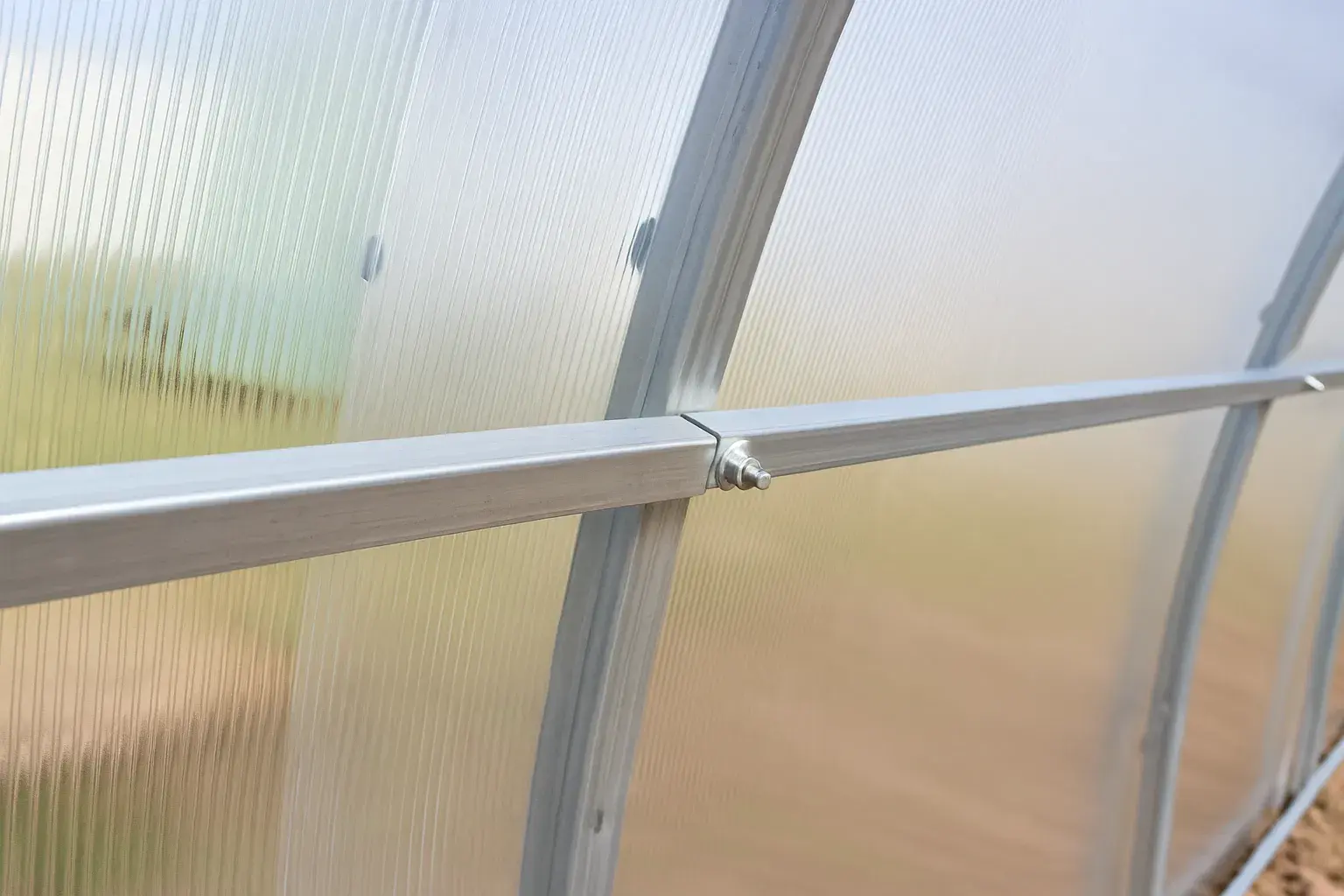
The first few hours determine whether the repair will involve patching or replacing the panels.
- External inspection. Holes, dents, cracks near the screws, sheets shifting out of their profiles, sagging mesh. Take photos of everything—for insurance and warranty purposes.
- Inspection from the inside in daylight. Microcracks appear as light-colored «stars» when held up to the light; they are documented even if there is no leak.
- Temporary sealing. Holes up to 3–4 cm: use clear polycarbonate tape or aluminum tape on both sides; cracks: use the same tape, leaving a 5-cm overlap on each side. This will hold until the sheet is replaced, for 1–2 seasons.
- Replacing a sheet, if there are more than 3–4 holes per sheet, the crack originates from a fastener, or the sheet has lost its shape. The entire roof sheet is replaced; the remaining sheets with «star-shaped» holes are scheduled for replacement next season.
- Net. A torn hail-proof net is repaired with a cord or the mesh is replaced; a stretched net is tightened.
- Plants. Trim off damaged leaves and shoots, and treat them with a fungicide (copper, biological products)—fungi can enter through the wounds; in 2–3 days, apply a foliar feeding of potassium or silicon.
- Inspecting the frame. Hail itself does not damage the frame, but wind combined with hail can dislodge the arches or tear out the fasteners; check the alignment and tightness.
Example. «Ideal» Greenhouse, 4×8 m, 6 mm polycarbonate, Khmelnytskyi Oblast, June: hail up to 3.5 cm in diameter for 15 minutes. Result: 2 dents without holes, 4 microcracks near the self-tapping screws, which were overtightened during DIY installation. Repair: replacement of 4 thermal washers and aluminum tape, 300 hryvnias. Neighboring 3×6-meter plastic greenhouse — Torn at 70%; repair cost: 3,500 UAH.
Greenhouse Insurance Against Hail
Insurance companies in Ukraine insure greenhouses as property (agricultural structures) against «natural disasters,» which include hail. Here are some details our clients often ask about:
- You can insure a greenhouse built on a foundation if you have proof of purchase (a receipt, contract, or product certificate—NovaTeplitsa greenhouses come with one).
- Plastic Greenhouses They are insured reluctantly or with a deductible of 20–30%; polycarbonate windows on a frame are standard.
- Crops are insured separately under agricultural insurance, and this coverage is virtually unavailable for backyard greenhouses.
- Cost: 1–2.5% of the insured amount per year; for a greenhouse costing 60,000 UAH, the annual cost is 600–1,500 UAH.
- To receive payment, you'll need photos of the damage, a report from the Hydrometeorological Center confirming hail on that day (issued upon request), and an inspection report.
A Comparison of Methods for Protecting Greenhouses from Hail
| Method | Protects against hail | Cost for a 3×6 m greenhouse | Service life | Cons | For whom |
|---|---|---|---|---|---|
| 200-micron reinforced film instead of 120-micron film | up to 2 cm | +1,000–2,000 UAH | 3–5 seasons | Remains vulnerable | Summer residents in regions with infrequent hail |
| 6 mm polycarbonate instead of 4 mm | up to 4 cm | +3,000–5,000 UAH | 10–15 years | — | All metropolitan areas, base solution |
| 8–10 mm polycarbonate | up to 5 cm | +8,000–12,000 UAH | 15+ years | Heavier, more expensive; a 3–5% reduction in light transmission | Farm-fresh, available year-round |
| Hail-proof netting on a frame | any | 3,000–6,000 UAH | 5–8 years for the mesh; the frame is designed to last indefinitely | Shading 8–15%, Maintenance, Snow | Regions with annual hailfall of 3+ cm |
| Proper installation (thermal washers, profiles, 1-meter spacing between arches) | increases the coating's durability by 30–50% | 0–1,000 UAH | For the entire term | Requires precision | All |
| Temporary shelter based on the forecast | up to 2–2.5 cm | 500–1,500 UAH | Reusable | We need to make it in time; shading | Add-on for any option |
| Insurance | compensates, does not protect | 600–1,500 UAH/year | — | Franchise, Documents | Expensive greenhouses on a foundation |
The optimal setup for central and western Ukraine, which we recommend to our customers: 6 mm UV-stabilized polycarbonate on a frame with 1-meter spacing, professional installation—and anti-hail netting over the gaps if hail larger than 3 cm occurs annually in your area. For the south and east—6 mm polycarbonate and temporary covering as needed based on the forecast.
Common Mistakes
- Buy 4-mm «lightweight» polycarbonate to save 1,500 UAH — and whether to replace the sheets after the first 3-centimeter hailstorm.
- Place the mesh directly on the roof without a gap—the impact is transferred to the sheet.
- Black Shading Mesh «For Everything» — a loss of 30% of light and a broken cell at 4 cm.
- Overscrewed self-tapping screws without thermal washers — Cracks from each impact radiate out from the mounting point.
- UV layer on the inside — The polycarbonate, which used to be 4 cm thick, is now less than 2 cm thick after three seasons.
- Open windows when the forecast calls for — damaged plants and a broken flap.
- Do not repair microcracks — After six months, water accumulates in the honeycombs, and the comb becomes cloudy and loses its strength.
- The net has not been removed for the winter; the tension frame is not designed to support snow — In the spring, the mesh frame rests on the roof.
Questions and Answers About Protecting a Greenhouse from Hail
Which type of polycarbonate can withstand hail?
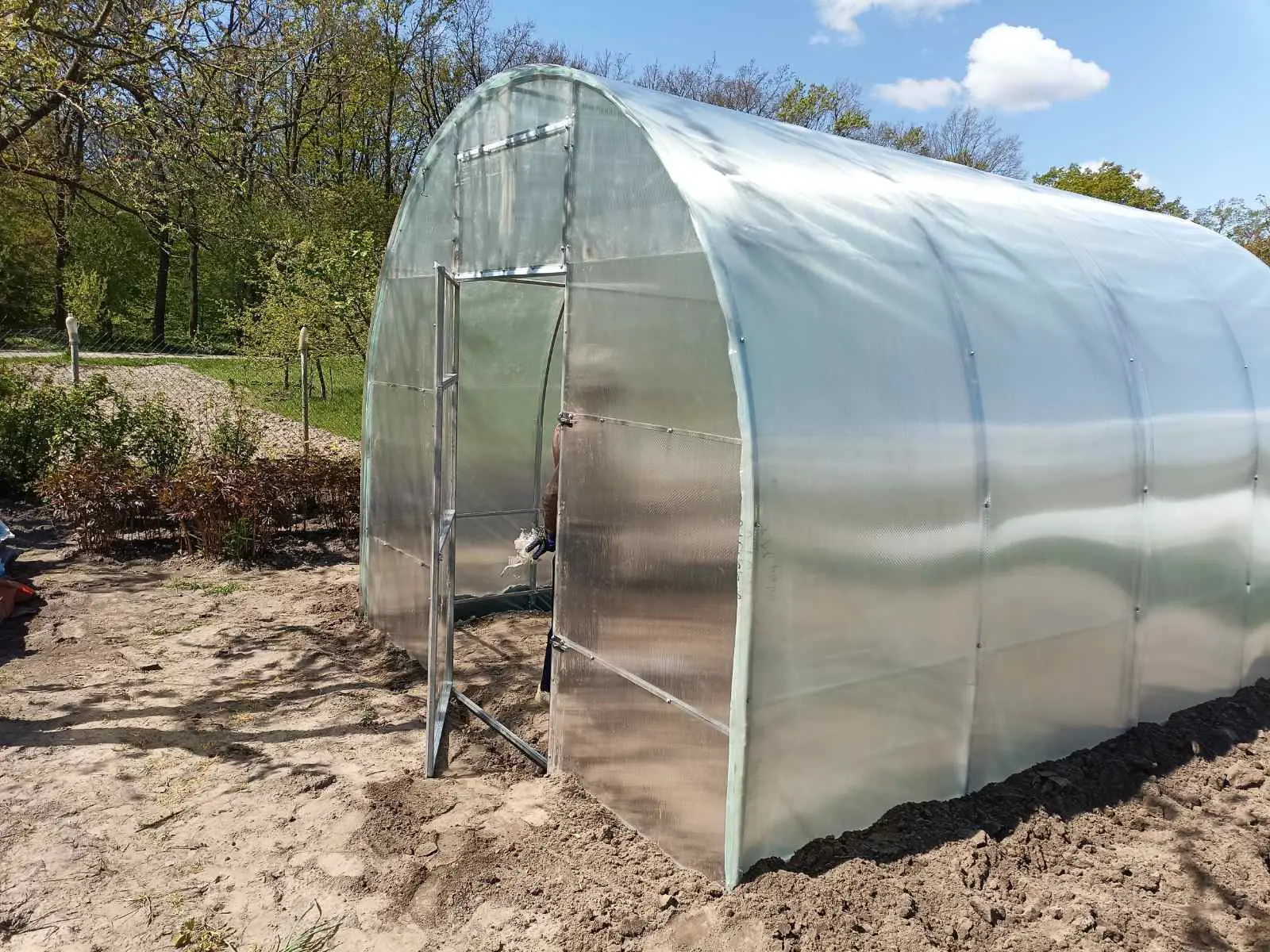
6-mm cellular polycarbonate with UV protection—up to 4 cm; 8–10 mm—up to 5 cm; for 6 cm and larger, you’ll need hail-resistant netting or solid polycarbonate.
Is it possible to install a hail protection net on an existing greenhouse?
Yes, for any frame with a 1-meter arch spacing: posts or brackets with a 15–30 cm gap, cable, and netting with grommets. For NovaTeplitsa greenhouses, we provide brackets designed to fit the profile.
How much shade does the net provide?
Transparent and white—8–15%; this is less than the shading caused by dust on polycarbonate after two growing seasons, and is imperceptible for most crops.
Plastic sheeting or polycarbonate, if we get hail every year?
6-mm polycarbonate under netting. Film under netting is also a viable option for farm greenhouses where the price per square meter is a key consideration: the netting provides complete protection.
Does the manufacturer's warranty cover damage caused by hail?
The polycarbonate warranty covers material defects, not natural disasters; hail is an insured event. However, if a sheet with the specified impact resistance is punctured by hail smaller than the specified size despite proper installation, this is a matter to be addressed with the sheet manufacturer, and we assist our customers in such cases.
What should you do if a hailstorm has passed but there's no visible damage?
Inspect the inside by holding it up to the light to check for microcracks, and check the honeycombs for water in a week. Hidden damage is the most insidious.
Results of Protecting the Greenhouse from Hail
- Hail up to 2 cm is not dangerous for polycarbonate but can tear the film; 3–4 cm is the limit for 4 mm sheets and the standard for 6 mm sheets; 5–6 cm is too much for any cellular polycarbonate without a mesh reinforcement.
- The basic protection for greenhouses against hail in central and western Ukraine consists of 6-mm polycarbonate with a UV-protective coating on the outer surface, 1-meter arch spacing, thermal washers, and profiles at the joints and ends.
- The only protection against hail of any kind is a 50–90 g/m² anti-hail net with 7–10 mm mesh, installed 15–30 cm above the roof and extending down the sides; 3,000–6,000 UAH for a 3×6 m greenhouse.
- A gap-free mesh on a sheet, a black shade mesh, and a gap-free tarp do not provide protection.
- According to the forecast, set up temporary shelter—such as agricultural fabric or netting on arches—1–3 hours before the front arrives; close windows and doors.
- After a hailstorm: take photos, inspect for holes, apply tape to punctures and cracks, replace panels with cracks caused by fasteners, and trim and treat plants.
- Insurance for a greenhouse on a foundation, including documentation—600–1,500 UAH per year; plastic-covered greenhouses are insured with a deductible.