



Why microcracks appear in polycarbonate: A practical analysis from NovaTeplitsa
Polycarbonate has earned the trust of farmers and private farm owners as the ideal material for greenhouses. Its advantages are obvious: high transparency, exceptional strength (200 times stronger than glass), light weight, and excellent thermal insulation properties. However, over time, some owners notice a fine network of cracks on the material’s surface, known as a «spiderweb.».
In this article, experts from «NovaTeplitsa,» drawing on their many years of experience working with polycarbonate, will explain in detail why microcracks form, how this affects the greenhouse, and, most importantly, how to prevent it.
What are microcracks and why are they dangerous?
Microcracks are small surface damages on a polycarbonate sheet. They are initially barely noticeable, but can deepen over time.
The danger lies not only in the aesthetic defect. Due to microcracks:
- Light transmittance decreases: The material becomes cloudy, and the plants in the greenhouse do not receive critical sunlight.
- Thermal insulation deteriorates: In cellular polycarbonate, cracks can lead to depressurization of the cells, allowing moisture and dirt to enter them.
- Strength decreases: The leaf becomes brittle and more vulnerable to mechanical stress such as hail or strong wind.
Understanding the reasons is the first step to durable and efficient greenhouse.
Reason #1: Lack of or poor quality UV protection
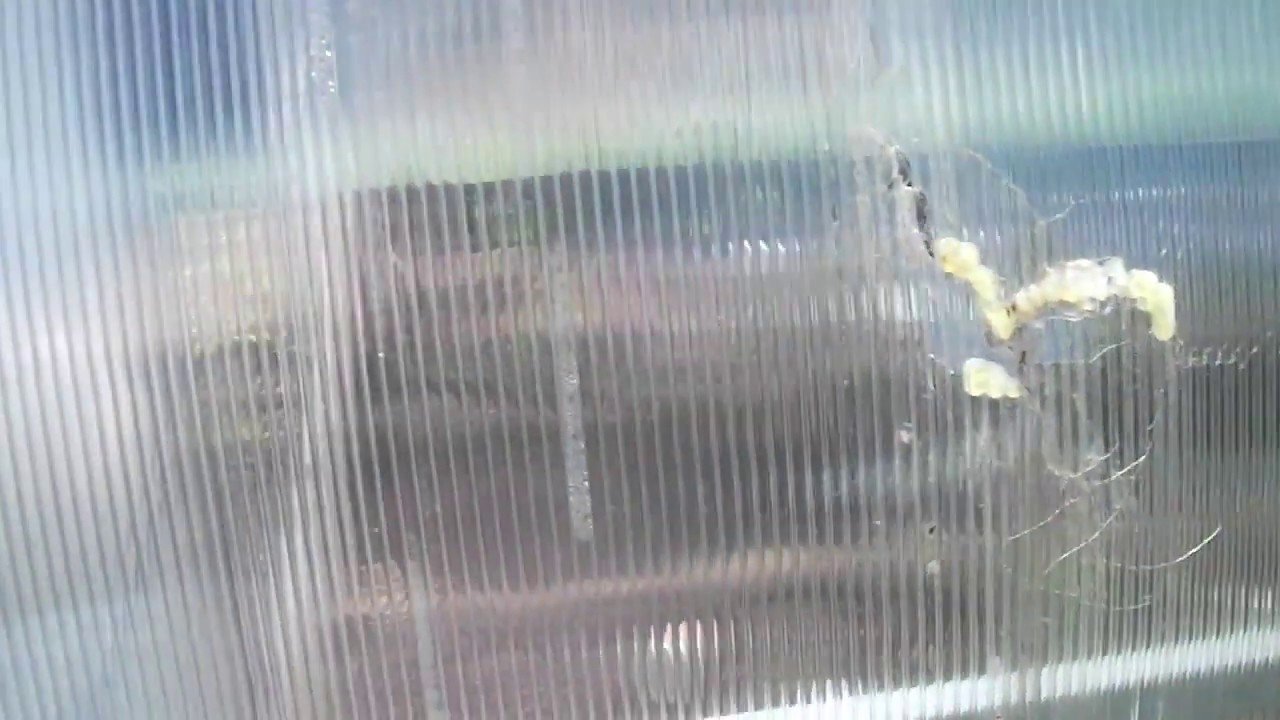
This is the most common and serious cause. Polycarbonate, by its chemical nature, is vulnerable to ultraviolet radiation. Without proper protection, sunlight destroys the polymer chains, making the material brittle and yellow.
How does this work: Qualitative polycarbonate for greenhouses It features a co-extruded UV-protective layer. This is not simply a coating, but a layer 30–60 microns thick that is «fused» into the sheet’s surface during the manufacturing process.
Risk factor: There are many cheap «no-name» polycarbonate sheets or so-called «lightweight» (eco) sheets on the market. These sheets either lack a protective layer, have a very thin one (10–15 microns), or have an unevenly applied protective layer. Such material begins to deteriorate as early as 2–3 years into use.
Comparison table: High-quality and inexpensive polycarbonate
| Feature / Parameter | High-quality certified polycarbonate | Cheap «eco» or «no-name» polycarbonate |
|---|---|---|
| UV protective layer | Coextrusion, 30-60 microns | None or < 20 microns, spray applied |
| Raw materials | 100% virgin polycarbonate | Addition of secondary raw materials (recycled PC) |
| Manufacturer's warranty | 10-15 years (real, documentary) | Absent, or 1-3 years (conditional) |
| Result in 3-5 years | Maintains transparency and strength | It turns yellow, becomes brittle, and becomes covered with microcracks. |
Expert advice: «NovaTeplitsa» always recommends asking the seller for certificates of conformity and checking the markings on the protective film covering the sheet. It clearly indicates which side has the UV layer (this side must face the outside of the greenhouse) and the length of the manufacturer’s warranty.
Reason #2: Installation errors and «internal stress»
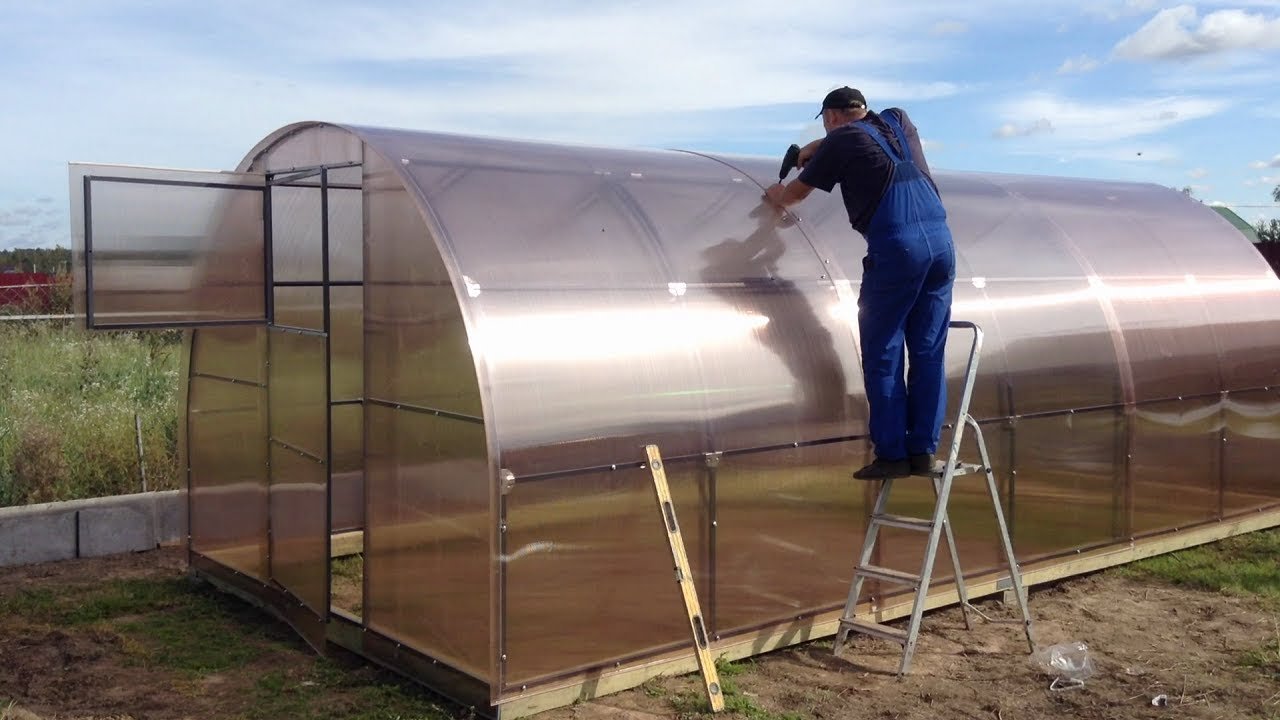
Even the most expensive premium polycarbonate can be ruined by improper installation. The main enemy is neglect. thermal expansion material. This is not just a recommendation, but a law of physics.
Technical data: Polycarbonate has a significant coefficient of linear thermal expansion—approximately 0.065 mm/m°C. This means that a 6-meter sheet, when subjected to a temperature difference of 50°C (for example, from -10°C in winter to +40°C in the sun in summer), can «grow» 1.95 cm in length!
Errors that lead to cracks:
- Rigid mount: The sheets are screwed directly to the frame. When the polycarbonate expands, it pushes against the fasteners, creating enormous internal stress. It is at these points that cracking begins.
- Incorrect holes: The holes for the self-tapping screws were drilled «to the limit» (with less than 2–3 mm of clearance).
- Using regular screws: Lack of sealing and cushioning.
The right solution (Installation technology):
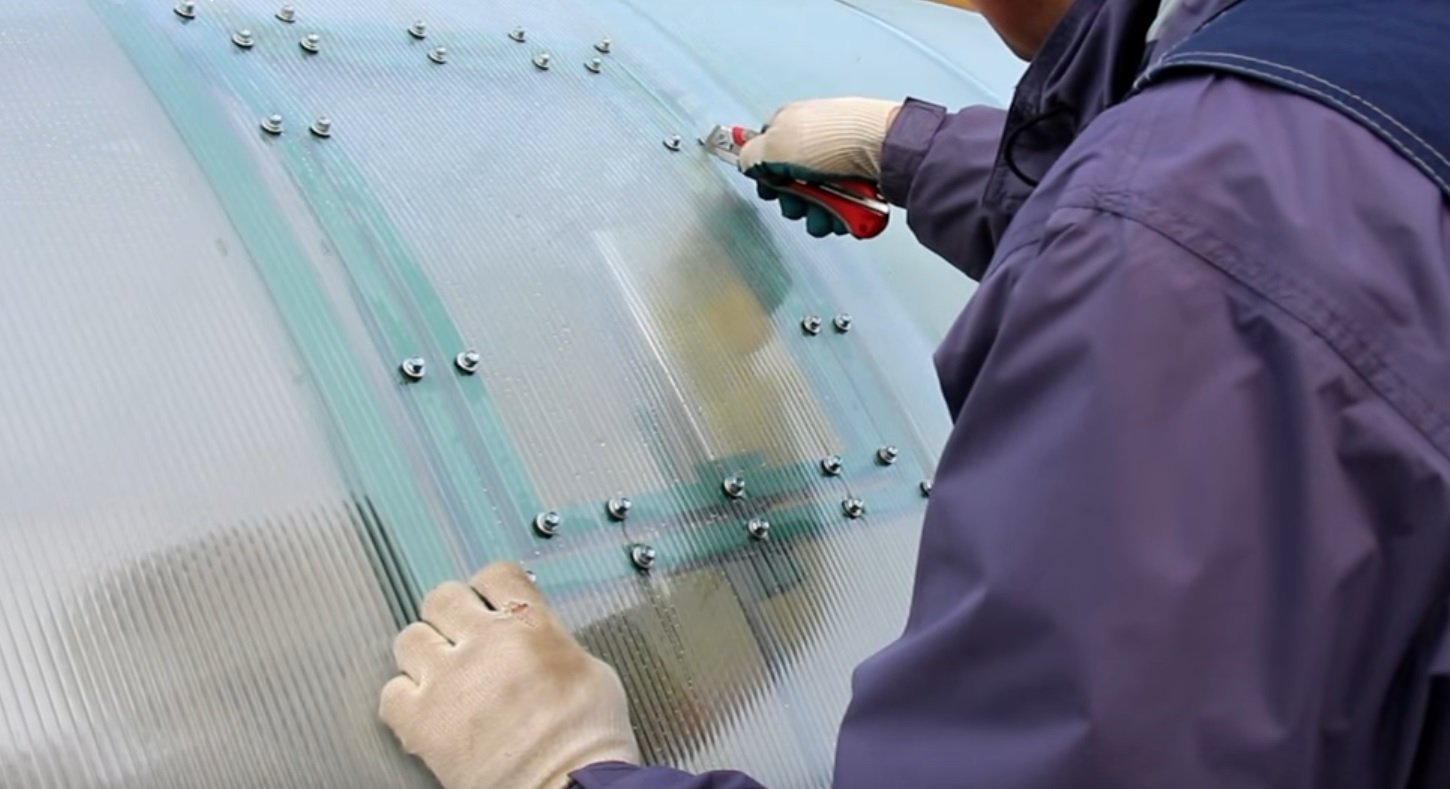
- Using special thermal washersThey have a foot that limits the pressure and a soft EPDM seal that cushions and seals the connection.
- Drill holes that are 2–3 mm wider than the diameter of the self-tapping screw's shank. This gives the sheet some «play» to allow for free thermal movement.
Reason #3: Exceeding the minimum bending radius
This problem is typical for arched greenhousesEach polycarbonate sheet (especially cellular) has a clear technical specification – the minimum allowable bending radius.
For example, for a sheet 4 mm thick this is approximately 0.7 m, for 6 mm – 1.05 m, for 8 mm – 1.4 m. (Data may vary depending on the manufacturer).
If the sheet is bent more during installation (that is, the arch is made steeper than permitted), it will develop constant critical internal stress. Add to this UV radiation and temperature fluctuations, and the appearance of microcracks is only a matter of time.
Reason #4: Chemical incompatibility
Despite its strength, polycarbonate is chemically sensitive to certain substances. Contact with these substances causes clouding and cracking.
What should be strictly avoided:
- Aggressive detergents: Contains ammonia, solvents, alkalis, chlorine.
- Some sealants: Especially vinegar-based sealants (silicones with a strong vinegar smell). They release an acid that destroys the polymer.
- PVC profiles: Over time, some low-quality PVC profiles or gaskets release plasticizers that chemically «attack» the polycarbonate, causing it to become brittle.
Professional approach: For sealing, use only neutral silicones (odorless), and for sealing, use EPDM rubber profiles or specialized polycarbonate profiles.
Conclusions of the Experts at «NovaTeplitsa»
The appearance of microcracks in polycarbonate is almost always the result of one of three factors or a combination of them:
- Saving on materials (purchase of a sheet without UV protection or from unknown raw materials).
- Unprofessional installation (ignoring thermal expansion).
- Design errors (the arch bend is too steep).
To ensure your greenhouse lasts for decades without losing its transparency or strength, follow these three simple rules:
- Buy certified materials from reliable suppliers who provide a full package of documents and an official guarantee.
- Trust installation to professionals who understand technical tolerances and use the correct components (thermal washers, neutral sealants, EPDM gaskets).
- Take proper care of your greenhouse, wash it only with a clean soapy solution without abrasives or harsh chemicals.
Need advice on choosing polycarbonate or an assessment of your greenhouse project? Contact the experts at «NovaTeplitsa.» We guarantee not only the quality of our materials but also technically sound installation, which is key to ensuring the longevity of your harvest.