



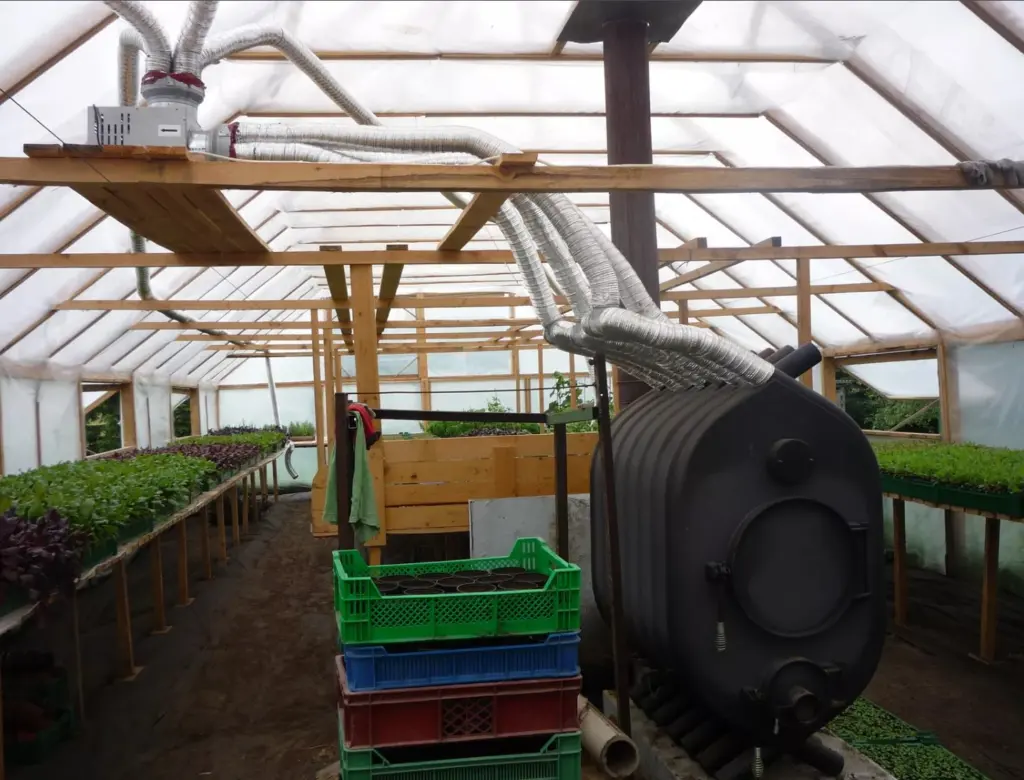
Why You Shouldn't Place a Heater Directly on the Ground in a Greenhouse: Physics, Safety, and Proper Installation
A greenhouse heater should not be placed directly on the ground for four reasons: the soil absorbs up to 30–40% of heat and warms up itself instead of the air; warm air rises toward the ridge and does not reach the plants; moist soil and condensation can damage electrical components and pose an electric shock hazard, and mulch, agricultural fiber, and dry plant debris near the heated unit can cause a fire. The correct height for most heaters is 30–60 cm above the ground on a non-flammable stand or bracket, with the airflow directed along the garden beds rather than toward them.
NovaTeplitsa has been manufacturing greenhouses since 1995, and over the past thirty years we have seen hundreds of heated greenhouses—from 3×6-meter garden greenhouses to farm blocks. Half of the problems with winter and spring heating that people bring to our attention aren’t related to the heater’s power, but to where it’s placed. In this article, we’ll explain what happens when a heater is placed directly on the ground in a greenhouse, which heaters should be raised and how, and which ones—on the contrary— are designed to operate directly in the soil, and how to set up a safe heating system for a polycarbonate or plastic film greenhouse.
What happens when the heater is placed on the ground?
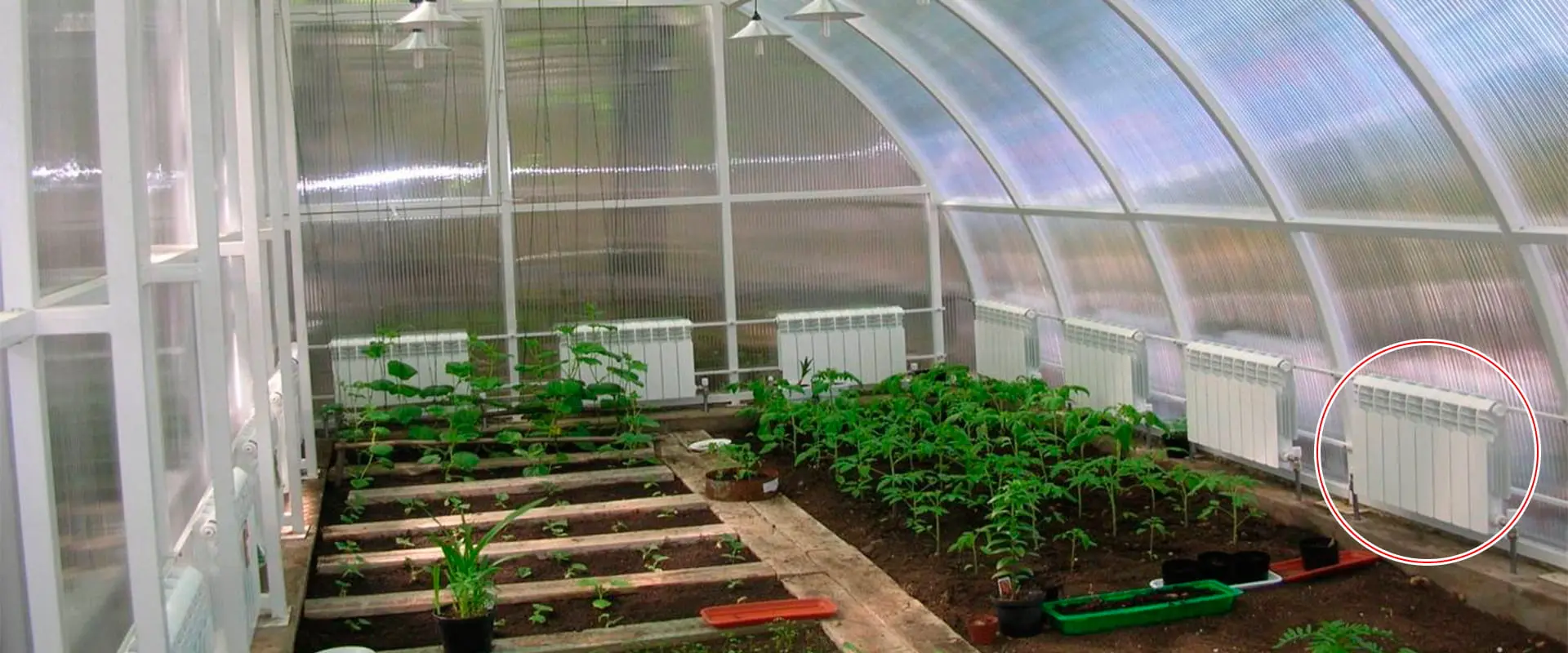
Let's break it down step by step: where does the heat go, and why don't the plants get it?.
The ground acts as a heat storage medium—but not to your advantage
Moist soil has a thermal conductivity of 1–2 W/m·K—40 to 80 times higher than that of air. A heater placed on the ground transfers some of its heat directly into the ground through radiation and contact, and the ground acts as an infinite heat sink: it draws the heat downward and outward toward the colder layers. A 2-kW heater on the ground heats a patch of soil with a diameter of 1–1.5 m to +30…+40 °C, while the air at plant height remains 5–8 °C cooler than it otherwise would be.
This is not a «warm bed.» A warm bed heats the roots evenly from below through a layer of organic matter; a ground-mounted heater in a greenhouse heats the top 5–10 cm of soil in one spot, dries it out, and overheats the roots of the nearest plants, while the rest of the soil remains cold.
Convection Works Against You
Warm air is lighter than cold air and rises. The floor heater creates an upward airflow that travels toward the ridge, heats the polycarbonate, and, through it, heats the outside. At the ridge of a 2.2-meter-tall greenhouse, the temperature is 6–10 °C higher than at floor level, even without forced circulation. The plants are located in the lower third of the greenhouse’s volume—the coldest zone.
By raising the heater in the greenhouse by 40–60 cm and directing the airflow horizontally along the garden beds, you force the warm air to pass through the plant zone before it rises. This does not increase the heater’s power, but it does increase the proportion of heat that reaches the leaves by 20–35%.
| Placement of a 2-kW heater in a 3×6×2.2-meter greenhouse | Air temperature at a height of 30 cm (seedling zone) | At a height of 1.2 m (tomato area) | Under the skate | Soil temperature beneath the sensor |
|---|---|---|---|---|
| On the ground, upward flow | +8 °C | +11 °C | +18 °C | +32 °C locally |
| On a 50-cm stand, the stream runs along the garden beds | +12 °C | +13 °C | +15 °C | +10 °C |
| On a 50-cm stand + 30-watt circulation fan | +13 °C | +13.5 °C | +14 °C | +10 °C |
Reference outdoor temperature: 0 °C, 6 mm polycarbonate; measurements taken in our test greenhouses. The difference between the first and third rows is 5 °C in the seedling area, with the same power consumption and the same electricity bills.
Moisture and electricity don't mix
The humidity in the greenhouse is 70–95%, and near the soil surface it is nearly 100%. In the mornings, condensation runs down the walls and forms droplets that settle on everything standing on the ground. An electric heater installed directly on the ground in the greenhouse is exposed to moisture in three ways: from below via the wet soil, from above via condensation on the polycarbonate panels, and from the side via irrigation. The result is oxidation of the contacts, a short to ground, tripping of the GFCI (if present), and, in the worst case, an electric shock if the device is touched with wet hands.
According to the Electrical Installation Code (PUE) and DBN V.2.5-23, a greenhouse is classified as a particularly damp space with a conductive floor. For such premises, electrical devices must have a protection rating of at least IP44 (IP54 for installation at ground level), be connected via a 30 mA ground-fault circuit interrupter (GFCI), and be properly grounded. A household convector heater with an IP20 rating installed on the earthen floor of a greenhouse violates all three requirements simultaneously.
Fire
There is always combustible material around a heater in an in-ground greenhouse: straw or grass mulch, agricultural fiber, plastic sheeting, dry leaves, plastic bottles used as heat accumulators, and wooden raised-bed sides. The fan heater housing heats up to 80–120 °C, the convector’s heating element to 300–400 °C, and the coil of an open-type infrared heater to 700 °C. Dry straw ignites at 250–300 °C, while polyethylene film melts at 110–130 °C and burns.
According to statistics from the State Emergency Service, greenhouses and outbuildings burn more often in winter than in summer, and in most cases, the cause is heating devices. A polycarbonate greenhouse with a metal frame does not burn on its own, but everything else inside it does burn, and at 150–200 °C, polycarbonate warps and permanently loses its transparency.
Dust, Soil, and Rodents
The fan on the floor of the heated greenhouse draws in soil dust and seeds; over the course of a season, the heating element becomes coated with a layer of debris that reduces its efficiency and gives off a burnt smell. Mice that hibernate in the greenhouse gnaw on the wires right at ground level.
Comment from a NovaTeplitsa engineer: «The most common scenario when responding to a complaint that «the greenhouse isn't heating up»: a 2-kW fan heater is sitting on the ground by the entrance, blowing upward; it’s +20 °C at the ridge, +7 °C on the seedlings, and there’s a patch of dry soil beneath the heater. We move it onto a stand, position it along the raised bed, add a 400 hryvnia fan—and the same greenhouse maintains +13 °C at the seedlings without any extra cost for electricity.».
How to Install Different Types of Heaters: A Table by Type
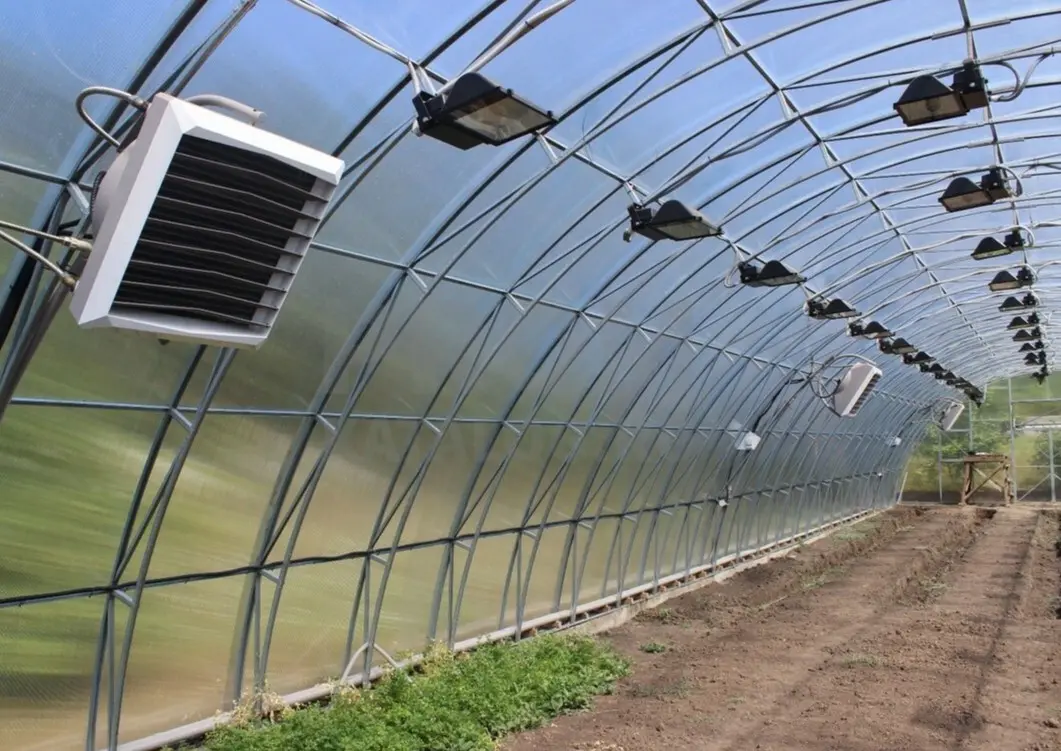
Different types of heaters in a greenhouse require different heights and different orientations, and each has its own «don’ts.».
| Heater Type | Minimum ground clearance | Distance from plants and fuel | Direction | Protection | What Not to Do |
|---|---|---|---|---|---|
| Fan Heater (Ceramic, Coil) | 40–60 cm, stand or bracket mounted on the frame | 1 m from the plants, 0.5 m from the plastic sheeting and agrotextile | Horizontally along the rows | IP44+, 30 mA RCD | On the ground, under the ridge, direct it toward the plants |
| Electric Convection Heater | 20–30 cm (according to the instructions—no less than 10–15 cm; in a greenhouse, the depth is greater due to moisture) | 0.5 m | Natural convection at the cold end | IP24+, RCD | Place it on the ground, cover it, and position it right up against the polycarbonate |
| Oil cooler | 10–15 cm on a non-flammable surface (tile, sheet metal) | 0.5 m | At the cold end | IP20 — for use only in dry areas, under a canopy to protect against condensation | On moist soil, near the watering area |
| Infrared panel / IR film | 1.5–2.5 m above the plants, suspended from the frame | 1.2–1.5 m to the leaves | Down to the ridges | IP44+, RCD | Within 1 meter of the plants—leaf burn; on the floor |
| Infrared heater with an open coil (carbon, quartz) | 1.8 m+, suspension | 1.5 m | Downward or at an angle | IP44, RCD | On the ground, next to the film, without a protective grille |
| Gas Infrared Heater (Cylinder-Fueled) | 30–50 cm on a stand; cylinder sold separately | 1.5 m | From plants | CO sensor, gas analyzer, ventilation | No ventilation (CO₂ and moisture), on the ground, cylinder in the greenhouse next to the heater |
| Indirect-heating diesel/kerosene heat gun | 30–50 cm, stand, exhaust vent to the outside | 1.5 m | Along the aisle | Chimney, CO sensor | Direct Heating in a Closed Greenhouse—Toxic Gases Affecting Plants |
| Solid-fuel stove, Buleryan | On a non-combustible surface (concrete, brick, metal) with an indentation | 1 m from any materials, 0.5 m screen | Chimney through the roof or the end of the building | Screen, fire-resistant chimney partition | Directly to the ground without a base; chimney through polycarbonate without a sleeve |
| Heating cable, heating mats | In the soil, at a depth of 20–30 cm beneath the raised bed or the bottom of the container | — | — | Temperature controller with in-ground sensor, GFCI | Directly on the ground, without backfill, without a thermostat |
| Water coils, pipes | 15–30 cm above the ground along the garden beds or in the ground (subsurface heating) | 20–30 cm from the stems | Along the garden beds | Faucet, expansion tank | Laying pipes on the ground without supports leads to corrosion and silting |
Two items in the table deserve special attention.
- IR panels on top, not on the bottom. An infrared heater in a greenhouse heats surfaces—the soil and leaves—rather than the air. This is its advantage: the air under the roof ridge doesn’t overheat, and the garden bed receives heat directly. But that is precisely why an IR panel on the floor heats a patch of soil and the gardener’s feet, rather than the plants. The correct placement is suspended from the frame at a height of 1.5–2.5 m above the garden bed, with a power rating of 100–150 W per square meter of garden bed area.
- A heating cable is the only «ground-mounted heater» that is actually designed for that purpose. It is buried 20–30 cm deep in the soil beneath the roots, with a thermostat set to +18…+22 °C. This is not air heating, but rather subsoil heating of the root zone—the most economical form of heating for seedlings. However, a cable laid on top of the garden bed without being covered with soil will overheat, dry out the surface, and pose a hazard to your feet.
Where exactly should you place a heater in a greenhouse?
Height is half the solution. The other half is location.
- Near a cold end or a cold wall. In a greenhouse with a single door, the cold end is the one with the door; in an east–west-facing greenhouse, the north wall is colder. The heater is placed there, and the airflow is directed along the garden beds toward the warm end.
- Not in the center. The heater in the center, under the eave, creates a warm spot at the top and cold edges; the plants by the door are the first to freeze.
- Not in front of the door or the window. A draft carries the airflow outward.
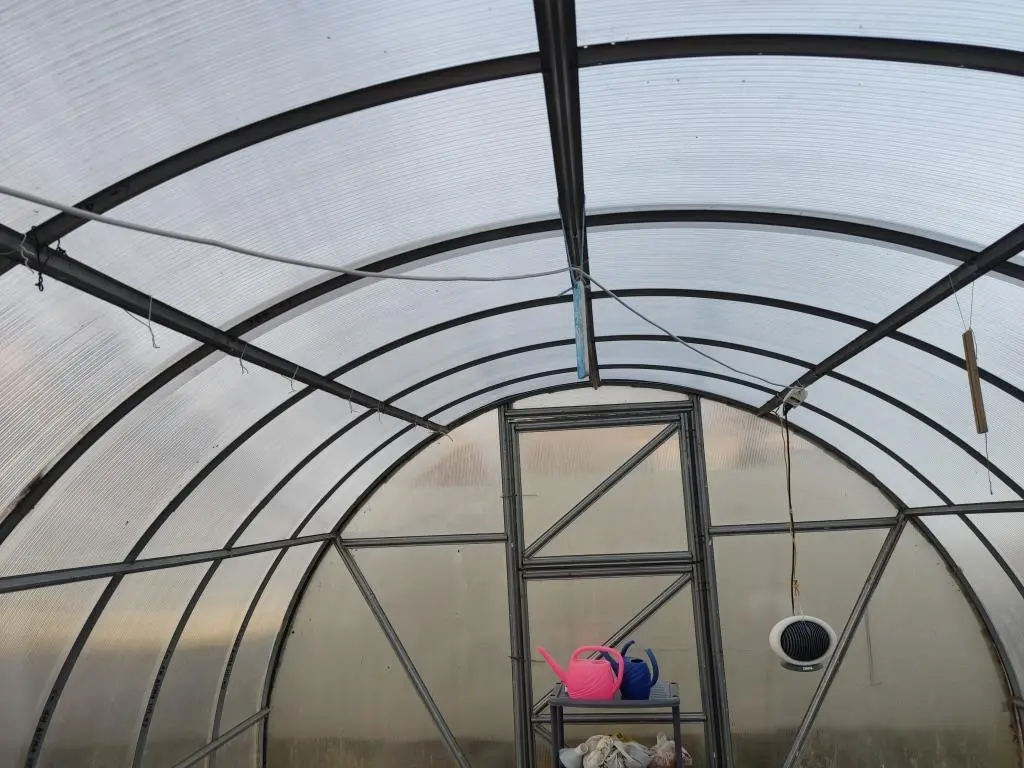
- Along the circulation path. If there is a circulation fan (20–40 W, mounted under the ridge, directed along the greenhouse toward the end), the heater should be located «downstream» so that the circulator fan distributes the warm air rather than disrupting the airflow.
- Two lower-powered devices are better than one high-powered one. In a 3×8-meter greenhouse, two 1-kW fan heaters placed at opposite ends will result in a temperature difference of 1–2 °C along the length; a single 2-kW fan heater will result in a difference of 5–7 °C.
- The thermostat sensor is located at the height of the plants. Not next to the heater (it will turn off as soon as it heats itself up) and not under the skid (it will keep the seedlings warm until they turn blue). A height of 30–50 cm for seedlings, 1–1.2 m for mature tomato plants, in the shade, and not against a wall.
Comment from a NovaTeplitsa agronomist: «The correct height for the heater is the height of your plants« growing point plus 20–30 cm, and it should be positioned lengthwise, not across, the garden beds. A stream of warm, dry air directed straight at the leaves at an outlet temperature of +40 °C will cause burns and cause tomato plants to drop their flowers within two days. We see this every spring: a fan heater »saves them from frost» and, in a single night, scorches a row of seedlings that was standing less than a meter away.”.
How to Mount a Heater on a Greenhouse Frame
Putting the device on a stool doesn't mean placing it on a stool. The stool in the greenhouse is made of wood (flammable), wobbly (if a watering hose catches on it, the device falls to the ground), and people sit on it.
Options we recommend:
- Bracket mounted on a frame arch or upright. The galvanized profile of NovaTeplitsa greenhouses can support 5–10 kg per mounting point without deforming; the bracket for a convector or fan heater is secured with self-tapping screws for metal or clamps through the profile. The height is adjustable; the unit does not touch the ground and does not obstruct passage.
- A shelf unit made of galvanized steel profiles between the uprights—for an oil-filled radiator or a gas-fired infrared heater; the bottom is covered with a sheet of metal to protect against condensation and splashes.
- Mounting to the ridge or the top framing — For IR panels and IR heaters: a chain or cable with height adjustment to raise the panel as the plants grow.
- Non-flammable ground-level area — For stoves and buleryans only: a 1×1-meter concrete slab or brick wall, set back 1 meter from any other materials, with a galvanized steel screen on the side facing the plants.
What not to do:
- Attach to plastic sheeting or polycarbonate—they are not load-bearing.
- Place it on a board, plywood, or pallet—a flammable surface.
- If hanging it on an extension cord, use only the standard bracket, and make sure the cord is long enough and not taut.
- Position the unit so that its hot side touches the frame post: the metal conducts heat outside and heats the polycarbonate at the point of contact.
Electrical System in a Greenhouse: The Minimum Safety Kit
A greenhouse heater is the most powerful electrical appliance on the property, and you shouldn't plug it in «using an extension cord from the house.».
| Element | Requirement | Why |
|---|---|---|
| Cable from the panel | VVGng 3×2.5 mm² for 2–3 kW, 3×4 mm² for 4–5 kW; when buried, in an HDPE pipe at a depth of 0.7 m or in an armored version | A 1.5 mm² extension cord heats up and melts at 2 kW |
| Automatic machine | 16 A for 2.5 mm², 25 A for 4 mm² | Cable Protection |
| RCD or double-pole circuit breaker | 30 mA, Type A | Personal protection in a damp room is mandatory |
| Grounding | A circuit near the greenhouse or from the house's electrical panel with a PE conductor | If the device's casing is live, that means current is flowing through your wet hands |
| An outlet in the greenhouse | IP44–IP54 with a cover, at a height of at least 1 m, in a condensation-free environment | Moisture |
| Temperature Controller | Standalone, with a remote sensor, IP44 | The device's built-in heater warms the area «around it» |
| Timer or controller | Optional: night mode, day/night | Savings of 15–25% |
The cost of such a kit is 4,000–8,000 UAH, including a 20–30-meter cable. That’s less than the cost of a single burned-out space heater—and incomparably less than the consequences of a fire.
Power Calculation: Why More Must Be Installed «On the Ground»
When a greenhouse heater is placed directly on the ground, its effective output must be adjusted: 25–35% of heat is lost into the ground and along the ridge, past the plants. A simplified calculation for a private greenhouse:
P (W) = S (m²) × k (W/m²·K) × ΔT (°C) × 1.2 ÷ η
where S is the area of the covering (for 3×6×2.2 m, this is approximately 55 m²), k is the heat transfer coefficient of the covering (plastic film ~6, 4-mm polycarbonate ~3.9, 6-mm polycarbonate ~3.5, with an internal thermal film ~2.5), ΔT is the desired temperature difference from the outside, 1.2 is the margin for gaps and vents, and η is the proportion of heat reaching the plants: 0.65–0.7 for a ground-level setup, 0.9–0.95 for a properly installed system with air circulation.
Example: 6 mm polycarbonate, outdoor temperature −5 °C, target temperature for seedlings is +12 °C. On the ground: 55 × 3.5 × 17 × 1.2 ÷ 0.67 ≈ 5,860 W. On a bracket with a circulator: 55 × 3.5 × 17 × 1.2 ÷ 0.92 ≈ 4,270 W. The difference is 1.6 kW, or about 13 kWh over an 8-hour night, or 60–65 UAH each night at the 2026 rate. Over a 60-night spring season—that’s 3,500–4,000 UAH just because the unit wasn’t in the right place.
We discussed how to reduce k itself—through the covering and the secondary insulation—in our article on winter heat loss in greenhouses and in our piece on protecting plants from temperature fluctuations; heating is always cheaper after insulation has been installed, rather than as a substitute for it.
Passive aids that operate specifically at ground level
There are certain items that must be placed on the ground, and they enhance the performance of any heater in a greenhouse:
- Water barrels and bottles Along the north wall is a thermal storage tank: 400–600 liters of water in a 3×6-meter greenhouse release 1.5–2 kWh overnight and maintain a temperature of +2…+3 °C without electricity.
- Dark mulch and black agricultural fabric On the ridges, the soil warms up in the sun during the day and releases heat to the roots at night. The agricultural fabric should be placed at least 0.5 m away from the heater.
- Warm Ridges with organic matter in the lower layer—+5…+8 °C above the soil temperature for 4–8 weeks.
- Second circuit — Arches with agrotextile over the raised bed or an inner thermal film: the heater warms a smaller volume rather than the entire greenhouse.
It is precisely this combination—an insulated loop, a storage tank on the ground, a heater mounted on a bracket at the cold end, a circulation pump under the ridge, and a sensor at plant height—that we find to be the most energy-efficient summer greenhouses among our customers.
Common Problems with Greenhouse Heaters
- A space heater on the floor by the entrance, blowing upward. The horse warms the street; the plants are in the cold.
- Direct the airflow toward the seedlings «to warm them up faster.». Leaf scorch and flower drop overnight.
- An oil-filled radiator on wet ground without a ground-fault circuit interrupter (GFCI). The housing is live; there is condensation in the terminal box.
- An IR panel on the floor or on a stool. It warms the ground and your feet, not the plants; the panel should be hung above the garden bed.
- A gas heater in a closed greenhouse overnight. Carbon monoxide, excess CO₂, and moisture; in the morning—condensation and diseased plants.
- A stove built directly on the ground without a base, with a chimney made of polycarbonate and no liner. Polycarbonate melts at 150 °C; fire hazard.
- The thermostat sensor on the unit. The device turns off after a minute; the greenhouse is cold.
- A 1.5 mm² extension cord from home. Overheating, melting, short circuits—most often right near the ground, where the coil is located.
- Cover the heater with agricultural fabric «so the heat doesn’t escape.». The most common cause of fires in summer greenhouses.
Safe Installation Checklist
- The unit is raised 30–60 cm (fan heater, convector) or suspended 1.5–2.5 m (infrared) from the ceiling on a non-combustible bracket or stand secured to the frame.
- Direct the water stream along the rows, not at the plants; keep it at least 1 m away from the nearest leaf.
- At least 0.5 m from plastic sheeting, agrotextile, mulch, and wooden sides (1 m from heaters, plus a screen).
- IP44 protection rating or higher; connection via a 30 mA ground-fault circuit interrupter (GFCI), grounding, and a cable with the specified cross-sectional area.
- A thermostat with a remote sensor located at plant height.
- A circulation pump mounted under the ridge, running the length of the greenhouse.
- Gas and liquid-fuel appliances—only if they are vented and equipped with a CO detector; stoves—must have a flue leading outside and a fire-resistant partition.
- Once a week: inspect the cord, clean dust from the grille, and make sure the appliance hasn't been moved or covered.
Frequently Asked Questions About Greenhouse Heaters
Can I place a heater on bricks inside a greenhouse?
As a temporary solution for an oil-filled radiator or convector heater—yes, provided the bricks are dry, the surface is level, and the unit doesn’t wobble. For a fan heater, a bracket mounted on a frame is better: bricks don’t provide the necessary height of 40–60 cm or the stability needed.
At what height should an infrared heater be hung in a greenhouse?
1.5–2.5 m above the ridge, at a rate of 100–150 W/m²; raise the lights as the plants grow so that there is at least 1.2 m between the lights and the leaves.
Is it possible to heat a greenhouse using only a heating cable buried in the ground?
For seedlings—yes, this is the most economical option: warm roots are more important than warm air. For mature tomato and cucumber plants in the winter, you’ll also need to heat the air.
Why doesn't a 2-kW heater warm up a 3×6-meter greenhouse?
Most often, it stands on the ground and heats the greenhouse; when it’s −5 °C outside and the greenhouse has 6-mm polycarbonate, it requires 4–6 kW, but with proper installation and insulation, it requires 3–4 kW.
Is an oil-filled radiator safe to use in a greenhouse?
Install only in a dry area protected from condensation, on a non-flammable surface, and with a ground-fault circuit interrupter (GFCI). Most oil-filled radiators have an IP20 rating and are not intended for use in damp areas.
Is it okay to leave a heater in the greenhouse overnight without supervision?
Electric models with IP44 rating, a thermostat, a ground-fault circuit interrupter (GFCI), and mounted on a bracket—yes. Gas, liquid-fuel, and wood-burning stoves—no.
A Brief Overview of Greenhouse Heaters
- A ground-mounted heater transfers 25–35% of heat to the soil and the ridge, rather than to the plants; at the same power output, the seedling area is 4–5 °C cooler.
- Damp soil and condensation can cause current leakage and corrosion; a greenhouse is a particularly damp environment, so IP44+ rating, a 30 mA GFCI, and grounding are required.
- Mulch, agricultural fabric, plastic sheeting, and boards near a heated unit can cause a fire; maintain a distance of at least 0.5 m; for stoves, maintain a distance of 1 m and use a heat shield.
- Fan heaters and convectors—mounted 30–60 cm away on a bracket at the cold end, with the airflow directed along the rows; Infrared panels—suspended 1.5–2.5 m above the raised bed; heaters—placed on a non-combustible base with a chimney venting to the outside.
- The only heater that belongs in the ground is a heating cable placed under a garden bed, equipped with a thermostat.
- The thermostat sensor is located at plant height; the circulator under the ridge evens out the temperature difference between the floor and the ridge.
- Proper installation saves 1.5–2 kW of power and 3,000–4,000 UAH during the spring season for the same greenhouse.